


Page 335 - The City and Guilds Textbook: Plumbing Book 1 for the Level 3 Apprenticeship (9189), Level 2 Technical Certificate (8202) and Level 2 Diploma (6035)
P. 335
Chapter 5 Cold water systems

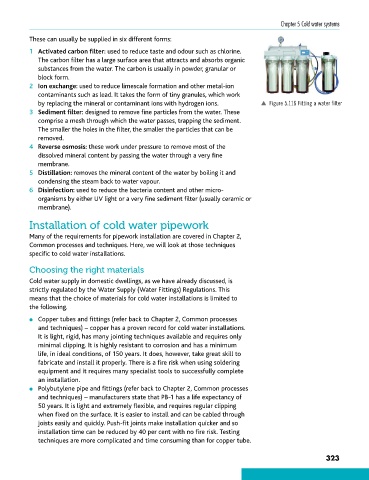
                These can usually be supplied in six different forms:

                1  Activated carbon filter: used to reduce taste and odour such as chlorine.
                   The carbon filter has a large surface area that attracts and absorbs organic
                   substances from the water. The carbon is usually in powder, granular or
                   block form.
                2  Ion exchange: used to reduce limescale formation and other metal-ion
                   contaminants such as lead. It takes the form of tiny granules, which work
                   by replacing the mineral or contaminant ions with hydrogen ions.        p  Figure 5.116 Fitting a water filter
                3  Sediment filter: designed to remove fine particles from the water. These
                   comprise a mesh through which the water passes, trapping the sediment.
                   The smaller the holes in the filter, the smaller the particles that can be
                   removed.
                4  Reverse osmosis: these work under pressure to remove most of the
                   dissolved mineral content by passing the water through a very fine
                   membrane.
                5  Distillation: removes the mineral content of the water by boiling it and
                   condensing the steam back to water vapour.
                6  Disinfection: used to reduce the bacteria content and other micro-
                   organisms by either UV light or a very fine sediment filter (usually ceramic or
                   membrane).


                Installation of cold water pipework
                Many of the requirements for pipework installation are covered in Chapter 2,
                Common processes and techniques. Here, we will look at those techniques
                specific to cold water installations.

                Choosing the right materials
                Cold water supply in domestic dwellings, as we have already discussed, is
                strictly regulated by the Water Supply (Water Fittings) Regulations. This
                means that the choice of materials for cold water installations is limited to
                the following.
                ●  Copper tubes and fittings (refer back to Chapter 2, Common processes
                   and techniques) – copper has a proven record for cold water installations.
                   It is light, rigid, has many jointing techniques available and requires only
                   minimal clipping. It is highly resistant to corrosion and has a minimum
                   life, in ideal conditions, of 150 years. It does, however, take great skill to
                   fabricate and install it properly. There is a fire risk when using soldering
                   equipment and it requires many specialist tools to successfully complete
                   an installation.
                ●  Polybutylene pipe and fittings (refer back to Chapter 2, Common processes
                   and techniques) – manufacturers state that PB-1 has a life expectancy of
                   50 years. It is light and extremely flexible, and requires regular clipping
                   when fixed on the surface. It is easier to install and can be cabled through
                   joists easily and quickly. Push-fit joints make installation quicker and so
                   installation time can be reduced by 40 per cent with no fire risk. Testing
                   techniques are more complicated and time consuming than for copper tube.

                                                                                                                323


        9781510416482.indb   323                                                                                    29/03/19   8:59 PM

