


Page 334 - The City and Guilds Textbook: Plumbing Book 1 for the Level 3 Apprenticeship (9189), Level 2 Technical Certificate (8202) and Level 2 Diploma (6035)
P. 334
The City & Guilds Textbook: Plumbing Book 1

                                            ●  Electronic (electromagnetic): these cause dissolved hardness salts and
                                               minerals to cluster together rather than form on surfaces.
                                            ●  Electrochemical: typically German or Austrian made, these conditioners
                                               contain a cartridge filled with ceramic beads that cause the magnesium and
                                               calcium crystals to precipitate. The conditioner units are usually quite large,
                                               requiring an electrical supply.

                p  Figure 5.114 Electromagnetic   The benefits of installing a water conditioner include:
                   water conditioner
                                            ●   reduction in the scale formation in pipes
                                            ●  reduction of limescale on taps
                                            ●   easier cleaning of showerheads and places where limescale may form.

                                            Water softeners
                                            A water softener is an appliance that is fitted directly to the water supply to
                                            a domestic dwelling or a commercial building, specifically designed to remove
                                            the water hardness. They are usually installed as close to water main entry
                                            into the building as possible. Most modern softeners are very compact and can
                                            easily be fitted under a kitchen sink.

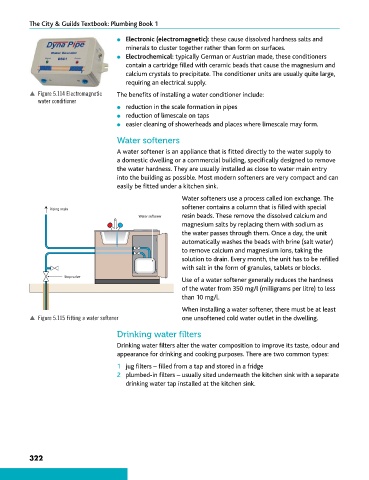
                                                                 Water softeners use a process called ion exchange. The
                                                                 softener contains a column that is filled with special
                       Rising main
                                                   Water softener  resin beads. These remove the dissolved calcium and
                                                                 magnesium salts by replacing them with sodium as
                                                                 the water passes through them. Once a day, the unit
                                                                 automatically washes the beads with brine (salt water)
                                                                 to remove calcium and magnesium ions, taking the
                                                                 solution to drain. Every month, the unit has to be refilled
                                                                 with salt in the form of granules, tablets or blocks.
                           Stop valve
                                                                 Use of a water softener generally reduces the hardness
                                                                 of the water from 350 mg/l (milligrams per litre) to less
                                                                 than 10 mg/l.
                                                                 When installing a water softener, there must be at least
                p  Figure 5.115 Fitting a water softener         one unsoftened cold water outlet in the dwelling.

                                            Drinking water filters
                                            Drinking water filters alter the water composition to improve its taste, odour and
                                            appearance for drinking and cooking purposes. There are two common types:

                                            1  jug filters – filled from a tap and stored in a fridge
                                            2  plumbed-in filters – usually sited underneath the kitchen sink with a separate
                                               drinking water tap installed at the kitchen sink.


                322


        9781510416482.indb   322                                                                                    29/03/19   8:59 PM

