


Page 332 - The City and Guilds Textbook: Plumbing Book 1 for the Level 3 Apprenticeship (9189), Level 2 Technical Certificate (8202) and Level 2 Diploma (6035)
P. 332
The City & Guilds Textbook: Plumbing Book 1

                                               hot and cold water is regulated as the water flows through the tube. If there
                                               is a drop in pressure on either supply, the shuttle is moved inside the mixing
                                               tube, increasing the flow on the reduced pressure side and decreasing the
                                               flow on the opposite supply. This maintains an even showering temperature
                                               when pressure fluctuations occur. They do not, however, react to changes in
                                               temperature.

                                            Thermostatic mixing valves
                                            Thermostatic mixing valves give the best overall temperature control of all the
                                            shower valves currently available. In most cases, the maximum temperature is
                                            pre-set by the manufacturer with a manual override for the end user. Incoming
                                            hot water temperature averages about 55°C and the cold supply at 15°C, giving a
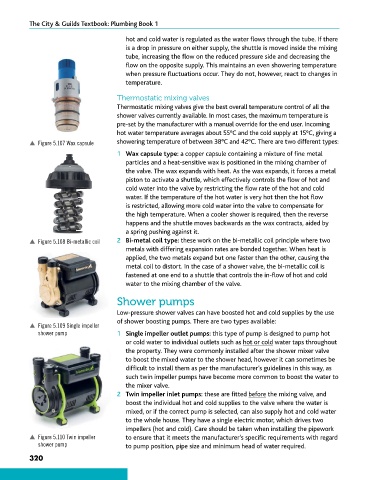
                p  Figure 5.107 Wax capsule  showering temperature of between 38°C and 42°C. There are two different types:
                                            1  Wax capsule type: a copper capsule containing a mixture of fine metal
                                               particles and a heat-sensitive wax is positioned in the mixing chamber of
                                               the valve. The wax expands with heat. As the wax expands, it forces a metal
                                               piston to activate a shuttle, which effectively controls the flow of hot and
                                               cold water into the valve by restricting the flow rate of the hot and cold
                                               water. If the temperature of the hot water is very hot then the hot flow
                                               is restricted, allowing more cold water into the valve to compensate for
                                               the high temperature. When a cooler shower is required, then the reverse
                                               happens and the shuttle moves backwards as the wax contracts, aided by
                                               a spring pushing against it.
                p  Figure 5.108 Bi-metallic coil  2  Bi-metal coil type: these work on the bi-metallic coil principle where two
                                               metals with differing expansion rates are bonded together. When heat is
                                               applied, the two metals expand but one faster than the other, causing the
                                               metal coil to distort. In the case of a shower valve, the bi-metallic coil is
                                               fastened at one end to a shuttle that controls the in-flow of hot and cold
                                               water to the mixing chamber of the valve.

                                            Shower pumps

                                            Low-pressure shower valves can have boosted hot and cold supplies by the use
                                            of shower boosting pumps. There are two types available:
                p  Figure 5.109 Single impeller
                   shower pump              1  Single impeller outlet pumps: this type of pump is designed to pump hot
                                               or cold water to individual outlets such as hot or cold water taps throughout
                                               the property. They were commonly installed after the shower mixer valve
                                               to boost the mixed water to the shower head, however it can sometimes be
                                               difficult to install them as per the manufacturer’s guidelines in this way, as
                                               such twin impeller pumps have become more common to boost the water to
                                               the mixer valve.
                                            2  Twin impeller inlet pumps: these are fitted before the mixing valve, and
                                               boost the individual hot and cold supplies to the valve where the water is
                                               mixed, or if the correct pump is selected, can also supply hot and cold water
                                               to the whole house. They have a single electric motor, which drives two
                                               impellers (hot and cold). Care should be taken when installing the pipework
                p  Figure 5.110 Twin impeller   to ensure that it meets the manufacturer’s specific requirements with regard
                   shower pump                 to pump position, pipe size and minimum head of water required.

                320


        9781510416482.indb   320                                                                                    29/03/19   8:59 PM

