


Page 336 - The City and Guilds Textbook: Plumbing Book 1 for the Level 3 Apprenticeship (9189), Level 2 Technical Certificate (8202) and Level 2 Diploma (6035)
P. 336
The City & Guilds Textbook: Plumbing Book 1

                                            Preparation, planning and positioning of pipes

                                            The installation of cold water systems needs to comply with the Water Supply
                                            (Water Fittings) Regulations and we must always consider the recommendations
                                            of BS EN 806 and BS 8558. The manufacturer’s instructions have to be
                                            followed with regard to the appliances installed and materials used.

                                            The installation procedures will vary depending on the property. For instance,
                                            the methods used on new buildings will differ from those in an occupied
                                            dwelling where the customer’s possessions will need to be taken into account.

                                            Irrespective of the property type, pipework runs need to be planned carefully.
                                            It is advisable to avoid positions where frost and heat could cause a problem,
                                            such as outside walls, in cellars and unheated roof spaces. Wherever possible,
                                            pipework should be positioned out of sight and boxed in where appropriate. It
                                            should be remembered, however, that pipework should not be buried in walls
                      INDUSTRY TIP          or floors unless provision can be made to make it accessible.


                 Notching and drilling of joists   Pipes in suspended timber floors
                 should be done carefully,   Pipes have been installed in timber floors for many years. Notching or drilling
                 taking care to follow the   of joists should not be carried out in joists or rafters 100 mm deep or less.
                 recommendations mentioned
                 in Chapter 2, Common       Notches should not be too tight for the pipes or creaking and ‘ticking’ noises
                 processes and techniques,   may become a problem as the pipes expand and contract. Pipes in notches
                 page 121.                  should be covered with joist clips to prevent excessive movement, and
                                            floorboards should be screwed (not nailed) when they are repositioned.
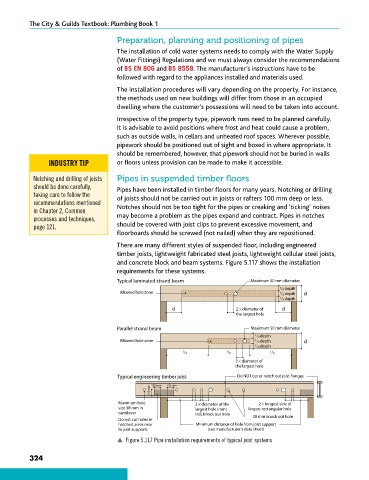
                                            There are many different styles of suspended floor, including engineered
                                            timber joists, lightweight fabricated steel joists, lightweight cellular steel joists,
                                            and concrete block and beam systems. Figure 5.117 shows the installation
                                            requirements for these systems.

                                            Typical laminated strand beam               Maximum 50 mm diameter
                                                                                                 1 / 3   depth
                                             Allowed hole zone                                   1 / 3   depth  d
                                                                                                 1 / 3   depth
                                                              d                    2 × diameter of   d
                                                                                   the largest hole

                                            Parallel strand beam                        Maximum 50 mm diameter
                                                                                         1 / 3   depth
                                             Allowed hole zone                           1 / 3   depth   d
                                                                                         1 / 3   depth
                                                                 1 / 3          1 / 3         1 / 3
                                                                                   2 × diameter of
                                                                                   the largest hole
                                            Typical engineering timber joist       Do NOT cut or notch out joist flanges
                                                       150 mm  150 mm  150 mm

                                             Maximum hole             2 × diameter of the   2 × longest side of
                                             size 38 mm in            largest hole (mm)  largest rectangular hole
                                             cantilever               incl. knock out hole
                                             Do not cut holes in                        38 mm knock out hole
                                             hatched areas near       Minimum distance of hole from joist support
                                             to joist supports            (see manufacturer's data sheet)
                                            p  Figure 5.117 Pipe installation requirements of typical joist systems

                324


        9781510416482.indb   324                                                                                    29/03/19   8:59 PM

