


Page 340 - The City and Guilds Textbook: Plumbing Book 1 for the Level 3 Apprenticeship (9189), Level 2 Technical Certificate (8202) and Level 2 Diploma (6035)
P. 340
The City & Guilds Textbook: Plumbing Book 1
Table 5.12
Lead pipes There are still hundreds of installations that contain lead pipe and there are situations where making a joint on
lead pipe is unavoidable. Joints using leaded grade D solder were banned in 1986. This means that proprietary
joints, such as lead locks and Philmac fittings, can be used only to convert the old lead pipe to workable
copper tubes or polybutylene pipes. Even so, we must still exercise caution as brass fittings such as lead locks
can cause galvanic corrosion to occur, which could lead to water contamination downstream of the fitting.
Wherever possible, lead pipe should be removed and replaced.
20 thread Occasionally, you may come across an installation that contains thick-walled screwed copper pipe jointed using
copper tube screwed brass fittings. This is known as 20 thread copper tube because the threads on the pipe measure
20 threads to the inch. Sizes 3 /8, ½ and ¾-inch pipes were generally used in domestic installations and are
not compatible with modern BS EN 1057 copper tubes or polybutylene pipes. Capillary converter fittings are
available but these are becoming increasingly rare.
BS 659 copper This type of copper tube was introduced in the 1950s and has a much thicker pipe wall compared with modern
tube copper tube. Jointing techniques were very similar to those of today, with both compression and capillary
fittings being used. However, the tube sizes are imperial and so converters are required for some sizes. ½-inch
tube will fit modern 15 mm, although it is a tight fit; ¾-inch is much smaller than modern 22 mm tube and so
must be converted; and 1-inch tube is extremely tight when used with 28 mm fittings, so a converter fitting is,
again, recommended. Both capillary and compression converter fittings are available.
Red band thin This kind of copper tube is identifiable by a red line running down the length of the tube and is mostly of
wall copper German origin. It was used in the early 1970s when copper tube was scarce due to a copper shortage. It is
tube very susceptible to pin hole corrosion. Only capillary joints should be made on this type of tube. The sizes of
tube are imperial.
Stainless steel Again, stainless steel tube was used extensively in the early 1970s due to a copper shortage. Unfortunately,
the tube was manufactured from low-grade stainless steel, which has led to many problems of corrosion.
Compression joints can be made onto this type of tube but care should be taken as it requires harder tightening
because stainless steel is a much harder metal than copper. Again, tube sizes are imperial.
High-density HDPE was used for underground service pipes from the external stop valve (boundary stop valve) to the
polyethylene dwelling. It is black in colour and comes in four grades (A, B, C and D). Compression fittings are still available
(HDPE) for this type of pipe but it should be noted that the grades have different wall thicknesses and so it is important
that the correct type of pipe insert is used when making joints. Conversion to blue MDPE is a fairly simple task
when the correct fitting is used.
CuPVC Better known as ‘PolyYork’, this is a plastic pipe that is suitable for cold water supplies only. It was again used
(chlorinated extensively in some parts of the UK during the early 1970s for cold water systems inside a domestic dwelling.
unplasticised Fittings used a solvent cement system that, once a joint was made, had to be left for 24 hours before testing
polyvinyl could take place. It is very susceptible to fracture and fitting blow-off. Care should be taken when this pipe is
chloride) encountered as it is extremely easy to fracture a fitting just by turning the water supply off!
Acorn An early version of polybutylene pipe that first appeared in the mid-1980s. It is compatible with all new polybutylene
(polybutylene) pipes and fittings, and copper tubes and compression fittings; however, a special pipe insert is required.
Testing cold water systems
● Before testing takes place, walk around the job and check that all joints have
been made correctly, that there are a sufficient number of pipe supports and
clips, and that you are happy that the installation conforms to the regulations.
● Close any open ends of pipes with cap ends.
● Pressure testing of the completed installation will depend upon the
materials used:
● Copper tubes – testing as detailed in BS EN 806 and in Chapter 2, Common
processes and techniques.
● Plastic (polybutylene PB-1) – this will depend on which test is being
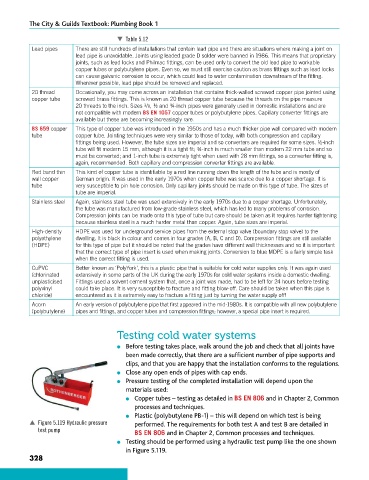
p Figure 5.119 Hydraulic pressure performed. The requirements for both test A and test B are detailed in
test pump
BS EN 806 and in Chapter 2, Common processes and techniques.
● Testing should be performed using a hydraulic test pump like the one shown
in Figure 5.119.
328
9781510416482.indb 328 29/03/19 8:59 PM

