


Page 337 - The City and Guilds Textbook: Plumbing Book 1 for the Level 3 Apprenticeship (9189), Level 2 Technical Certificate (8202) and Level 2 Diploma (6035)
P. 337
Chapter 5 Cold water systems

                Cold water pipes should not be installed in the same notch as hot water and
                central heating pipes. There must be a minimum horizontal distance of
                300 mm between cold water pipes and any hot water/central heating pipes to
                prevent radiated heat from warming the cold drinking water. Where there is a
                significant risk of cold water pipes being warmed by other pipework, the cold
                water installation should be lagged. To eliminate the risk of contamination from
                undue warming, the cold water pipework must never be allowed to exceed a
                temperature of 25°C.

                Pipes in walls and sleeved through walls

                According to Defra’s guidance on the Water Supply (Water Fittings)
                Regulations 1999:
                Unless they are located in an internal wall which is not a solid wall, a chase or
                duct which may readily be removed or exposed, or under a suspended floor
                which may be readily removed and replaced, or to which there is access, water
                fittings shall not be:
                1  Located in the cavity of a cavity wall, or;
                2  Embedded in any wall or solid floor, or;
                3  Installed below a suspended or solid floor at ground level.
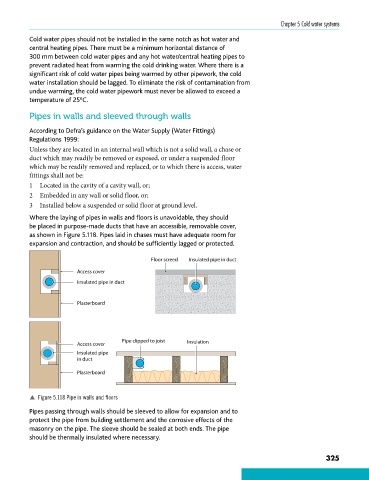
                Where the laying of pipes in walls and floors is unavoidable, they should
                be placed in purpose-made ducts that have an accessible, removable cover,
                as shown in Figure 5.118. Pipes laid in chases must have adequate room for
                expansion and contraction, and should be sufficiently lagged or protected.

                                                       Floor screed  Insulated pipe in duct

                               Access cover
                               Insulated pipe in duct


                               Plasterboard


                                              Pipe clipped to joist  Insulation
                               Access cover
                               Insulated pipe
                               in duct

                               Plasterboard


                p  Figure 5.118 Pipe in walls and floors

                Pipes passing through walls should be sleeved to allow for expansion and to
                protect the pipe from building settlement and the corrosive effects of the
                masonry on the pipe. The sleeve should be sealed at both ends. The pipe
                should be thermally insulated where necessary.


                                                                                                                325


        9781510416482.indb   325                                                                                    29/03/19   8:59 PM

