


Page 470 - The City and Guilds Textbook: Plumbing Book 1 for the Level 3 Apprenticeship (9189), Level 2 Technical Certificate (8202) and Level 2 Diploma (6035)
P. 470
The City & Guilds Textbook: Plumbing Book 1
Traditional boilers (non-condensing)
Traditional non-condensing boilers have been around for many years and in
many different forms. Usually, they contain cast iron heat exchangers, although
some models are low water content with copper or aluminium heat exchangers.
Traditional boilers (condensing)
A condensing traditional boiler does not give instantaneous hot water. It
requires to be installed in conjunction with a hot water storage system and
heating system. It contains an expansion vessel, filling loop and pressure relief
valve, and does not require a feed and expansion cistern.
Boilers with cast iron heat exchangers
For many years, boilers were made with cast iron heat exchangers. They were
often very large and heavy, even for small domestic systems. Some heat
exchangers were made from cast iron, which was cast in a single block, while
older types were made up of cast iron sections that were bolted together. The
more sections a boiler had, the bigger the heat output.
Fuel efficiency was, typically, 55 to 78 per cent, with much wasted heat
escaping through the flue. Most traditional boilers were fitted onto open vented
systems but sealed (pressurised) systems could also be installed with the
inclusion of an external expansion vessel and associated controls.
Cast iron boilers can be found either freestanding (floor mounted) or wall
mounted, using a variety of flue types:
l open flued
l room sealed (natural draught)
l fan-assisted room sealed (forced draught).
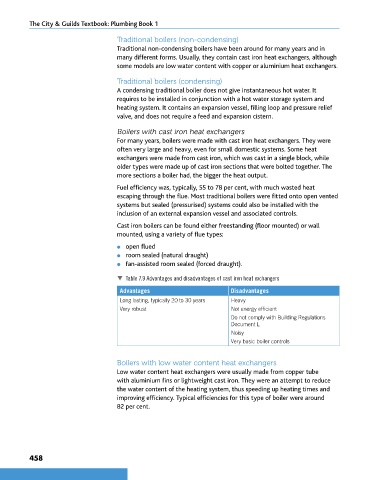
Table 7.9 Advantages and disadvantages of cast iron heat exchangers
Advantages Disadvantages
Long lasting, typically 20 to 30 years Heavy
Very robust Not energy efficient
Do not comply with Building Regulations
Document L
Noisy
Very basic boiler controls
Boilers with low water content heat exchangers
Low water content heat exchangers were usually made from copper tube
with aluminium fins or lightweight cast iron. They were an attempt to reduce
the water content of the heating system, thus speeding up heating times and
improving efficiency. Typical efficiencies for this type of boiler were around
82 per cent.
458
9781510416482.indb 458 29/03/19 9:03 PM

