


Page 474 - The City and Guilds Textbook: Plumbing Book 1 for the Level 3 Apprenticeship (9189), Level 2 Technical Certificate (8202) and Level 2 Diploma (6035)
P. 474
The City & Guilds Textbook: Plumbing Book 1
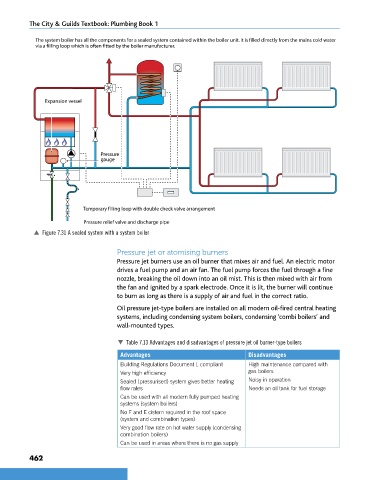
The system boiler has all the components for a sealed system contained within the boiler unit. It is filled directly from the mains cold water
via a filling loop which is often fitted by the boiler manufacturer.
Expansion vessel
Pressure
gauge
Temporary filling loop with double check valve arrangement
Pressure relief valve and discharge pipe
p Figure 7.31 A sealed system with a system boiler
Pressure jet or atomising burners
Pressure jet burners use an oil burner that mixes air and fuel. An electric motor
drives a fuel pump and an air fan. The fuel pump forces the fuel through a fine
nozzle, breaking the oil down into an oil mist. This is then mixed with air from
the fan and ignited by a spark electrode. Once it is lit, the burner will continue
to burn as long as there is a supply of air and fuel in the correct ratio.
Oil pressure jet-type boilers are installed on all modern oil-fired central heating
systems, including condensing system boilers, condensing ‘combi boilers’ and
wall-mounted types.
Table 7.13 Advantages and disadvantages of pressure jet oil burner-type boilers
Advantages Disadvantages
Building Regulations Document L compliant High maintenance compared with
Very high efficiency gas boilers
Sealed (pressurised) system gives better heating Noisy in operation
flow rates Needs an oil tank for fuel storage
Can be used with all modern fully pumped heating
systems (system boilers)
No F and E cistern required in the roof space
(system and combination types)
Very good flow rate on hot water supply (condensing
combination boilers)
Can be used in areas where there is no gas supply
462
9781510416482.indb 462 29/03/19 9:03 PM

