Page 472 - The City and Guilds Textbook: Plumbing Book 1 for the Level 3 Apprenticeship (9189), Level 2 Technical Certificate (8202) and Level 2 Diploma (6035)
P. 472
The City & Guilds Textbook: Plumbing Book 1

                                              Table 7.11 Advantages and disadvantages of non-condensing combination boilers

                                             Advantages                          Disadvantages
                                             Instantaneous hot water supply      Not energy efficient
                                             Sealed system means no F and E cistern   Very large in size
                                             required in the roof space          Do not comply with Building Regulations
                                                                                 Document L
                                                                                 Can be very noisy
                                                                                 High maintenance compared with other
                                                                                 boilers
                                                                                 Poor hot water flow rates
                                                                                 Difficult to maintain


                                            Condensing boilers
                                            A more recent addition to the gas central heating family is the condensing
                                            boiler. These work in a very different way from the traditional boiler.

                                            Natural gas, when it is combusted, contains CO , nitrogen and water vapour. As
                                                                                       2
                                            the flue gases cool, the water vapour condenses to form water droplets. It is this
                KEY TERM                    process that condensing boilers use.
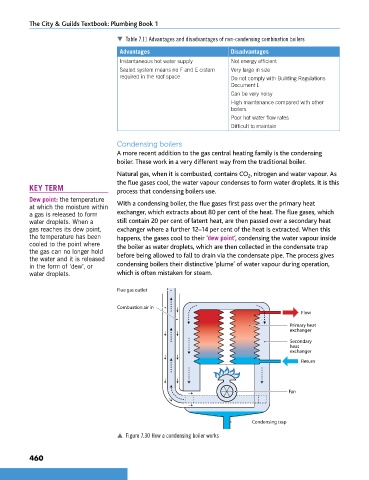
                Dew point: the temperature   With a condensing boiler, the flue gases first pass over the primary heat
                at which the moisture within
                a gas is released to form   exchanger, which extracts about 80 per cent of the heat. The flue gases, which
                water droplets. When a      still contain 20 per cent of latent heat, are then passed over a secondary heat
                gas reaches its dew point,   exchanger where a further 12–14 per cent of the heat is extracted. When this
                the temperature has been    happens, the gases cool to their ‘dew point’, condensing the water vapour inside
                cooled to the point where   the boiler as water droplets, which are then collected in the condensate trap
                the gas can no longer hold   before being allowed to fall to drain via the condensate pipe. The process gives
                the water and it is released
                in the form of ‘dew’, or    condensing boilers their distinctive ‘plume’ of water vapour during operation,
                water droplets.             which is often mistaken for steam.

                                            Flue gas outlet


                                            Combustion air in
                                                                                                        Flow
                                                                                                    Primary heat
                                                                                                    exchanger
                                                                                                    Secondary
                                                                                                    heat
                                                                                                    exchanger
                                                                                                        Return


                                                                                                    Fan


                                                                                        Condensing trap
                                            p  Figure 7.30 How a condensing boiler works


                460


        9781510416482.indb   460                                                                                    29/03/19   9:03 PM
   467   468   469   470   471   472   473   474   475   476   477