


Page 476 - The City and Guilds Textbook: Plumbing Book 1 for the Level 3 Apprenticeship (9189), Level 2 Technical Certificate (8202) and Level 2 Diploma (6035)
P. 476
The City & Guilds Textbook: Plumbing Book 1
Table 7.14 Advantages and disadvantages of vapourising oil burner-type boilers
Advantages Disadvantages
Very quiet in operation Very limited use (cookers only)
Typical flue systems for central heating
appliances
All central heating appliances need a flue to remove the products of combustion
safely to the outside. The basic concept is to produce an updraught, whether by
natural means or by the use of a fan, to eject the fumes away from the building.
There are two flue concepts:
1 open flues
2 room sealed (balanced) flues.
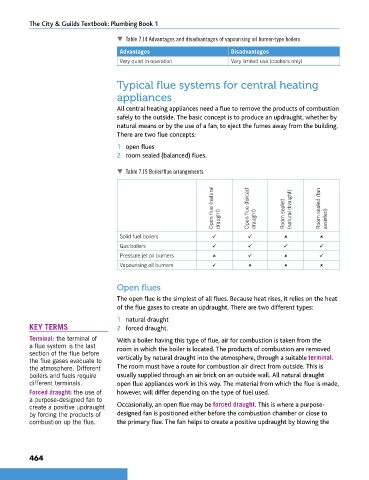
Table 7.15 Boiler/flue arrangements
Open flue (natural draught) Open flue (forced draught) Room sealed (natural draught) Room sealed (fan assisted)
Solid fuel boilers ü ü û û
Gas boilers ü ü ü ü
Pressure jet oil burners û ü û ü
Vapourising oil burners ü û û û
Open flues
The open flue is the simplest of all flues. Because heat rises, it relies on the heat
of the flue gases to create an updraught. There are two different types:
1 natural draught
KEY TERMS 2 forced draught.
Terminal: the terminal of With a boiler having this type of flue, air for combustion is taken from the
a flue system is the last room in which the boiler is located. The products of combustion are removed
section of the flue before
the flue gases evacuate to vertically by natural draught into the atmosphere, through a suitable terminal.
the atmosphere. Different The room must have a route for combustion air direct from outside. This is
boilers and fuels require usually supplied through an air brick on an outside wall. All natural draught
different terminals. open flue appliances work in this way. The material from which the flue is made,
Forced draught: the use of however, will differ depending on the type of fuel used.
a purpose-designed fan to
create a positive updraught Occasionally, an open flue may be forced draught. This is where a purpose-
by forcing the products of designed fan is positioned either before the combustion chamber or close to
combustion up the flue. the primary flue. The fan helps to create a positive updraught by blowing the
464
9781510416482.indb 464 29/03/19 9:03 PM

