


Page 489 - The City and Guilds Textbook: Plumbing Book 1 for the Level 3 Apprenticeship (9189), Level 2 Technical Certificate (8202) and Level 2 Diploma (6035)
P. 489
Chapter 7 Central heating systems

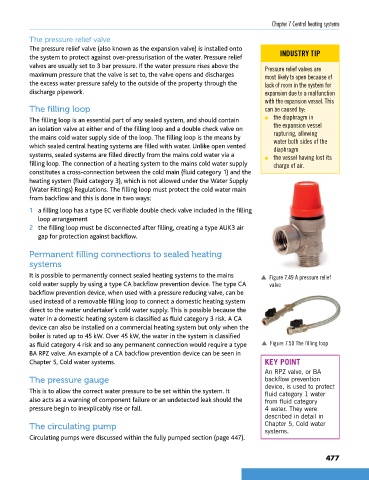
                The pressure relief valve
                The pressure relief valve (also known as the expansion valve) is installed onto   INDUSTRY TIP
                the system to protect against over-pressurisation of the water. Pressure relief
                valves are usually set to 3 bar pressure. If the water pressure rises above the   Pressure relief valves are
                maximum pressure that the valve is set to, the valve opens and discharges   most likely to open because of
                the excess water pressure safely to the outside of the property through the   lack of room in the system for
                discharge pipework.                                                         expansion due to a malfunction
                                                                                            with the expansion vessel. This
                The filling loop                                                            can be caused by:

                The filling loop is an essential part of any sealed system, and should contain   l  the diaphragm in
                an isolation valve at either end of the filling loop and a double check valve on   the expansion vessel
                the mains cold water supply side of the loop. The filling loop is the means by   rupturing, allowing
                                                                                               water both sides of the
                which sealed central heating systems are filled with water. Unlike open vented   diaphragm
                systems, sealed systems are filled directly from the mains cold water via a   l  the vessel having lost its
                filling loop. The connection of a heating system to the mains cold water supply   charge of air.
                constitutes a cross-connection between the cold main (fluid category 1) and the
                heating system (fluid category 3), which is not allowed under the Water Supply
                (Water Fittings) Regulations. The filling loop must protect the cold water main
                from backflow and this is done in two ways:
                1  a filling loop has a type EC verifiable double check valve included in the filling
                   loop arrangement
                2  the filling loop must be disconnected after filling, creating a type AUK3 air
                   gap for protection against backflow.


                Permanent filling connections to sealed heating
                systems
                It is possible to permanently connect sealed heating systems to the mains   p  Figure 7.49 A pressure relief
                cold water supply by using a type CA backflow prevention device. The type CA   valve
                backflow prevention device, when used with a pressure reducing valve, can be
                used instead of a removable filling loop to connect a domestic heating system
                direct to the water undertaker’s cold water supply. This is possible because the
                water in a domestic heating system is classified as fluid category 3 risk. A CA
                device can also be installed on a commercial heating system but only when the
                boiler is rated up to 45 kW. Over 45 kW, the water in the system is classified
                as fluid category 4 risk and so any permanent connection would require a type   p  Figure 7.50 The filling loop
                BA RPZ valve. An example of a CA backflow prevention device can be seen in
                Chapter 5, Cold water systems.                                              KEY POINT
                                                                                            An RPZ valve, or BA
                The pressure gauge                                                          backflow prevention
                                                                                            device, is used to protect
                This is to allow the correct water pressure to be set within the system. It   fluid category 1 water
                also acts as a warning of component failure or an undetected leak should the   from fluid category
                pressure begin to inexplicably rise or fall.                                4 water. They were
                                                                                            described in detail in
                The circulating pump                                                        Chapter 5, Cold water
                                                                                            systems.
                Circulating pumps were discussed within the fully pumped section (page 447).


                                                                                                                477


        9781510416482.indb   477                                                                                    29/03/19   9:03 PM

