


Page 490 - The City and Guilds Textbook: Plumbing Book 1 for the Level 3 Apprenticeship (9189), Level 2 Technical Certificate (8202) and Level 2 Diploma (6035)
P. 490
The City & Guilds Textbook: Plumbing Book 1


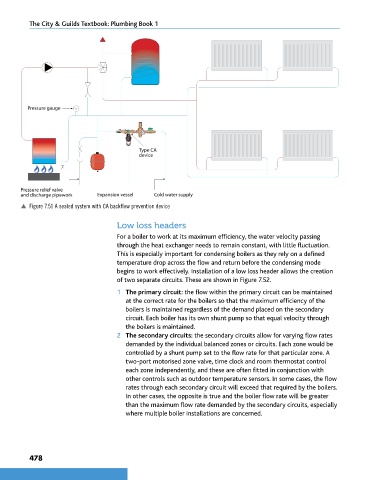
               Pressure gauge


                                                     60
                                                    40  80
                                                    20  100
                                                    0
                                                   Type CA
                                                   device


             Pressure relief valve
             and discharge pipework   Expansion vessel  Cold water supply
             p  Figure 7.51 A sealed system with CA backflow prevention device


                                            Low loss headers
                                            For a boiler to work at its maximum efficiency, the water velocity passing
                                            through the heat exchanger needs to remain constant, with little fluctuation.
                                            This is especially important for condensing boilers as they rely on a defined
                                            temperature drop across the flow and return before the condensing mode
                                            begins to work effectively. Installation of a low loss header allows the creation
                                            of two separate circuits. These are shown in Figure 7.52.

                                            1  The primary circuit: the flow within the primary circuit can be maintained
                                               at the correct rate for the boilers so that the maximum efficiency of the
                                               boilers is maintained regardless of the demand placed on the secondary
                                               circuit. Each boiler has its own shunt pump so that equal velocity through
                                               the boilers is maintained.
                                            2  The secondary circuits: the secondary circuits allow for varying flow rates
                                               demanded by the individual balanced zones or circuits. Each zone would be
                                               controlled by a shunt pump set to the flow rate for that particular zone. A
                                               two-port motorised zone valve, time clock and room thermostat control
                                               each zone independently, and these are often fitted in conjunction with
                                               other controls such as outdoor temperature sensors. In some cases, the flow
                                               rates through each secondary circuit will exceed that required by the boilers.
                                               In other cases, the opposite is true and the boiler flow rate will be greater
                                               than the maximum flow rate demanded by the secondary circuits, especially
                                               where multiple boiler installations are concerned.


                478


        9781510416482.indb   478                                                                                    29/03/19   9:03 PM

