


Page 487 - The City and Guilds Textbook: Plumbing Book 1 for the Level 3 Apprenticeship (9189), Level 2 Technical Certificate (8202) and Level 2 Diploma (6035)
P. 487
Chapter 7 Central heating systems


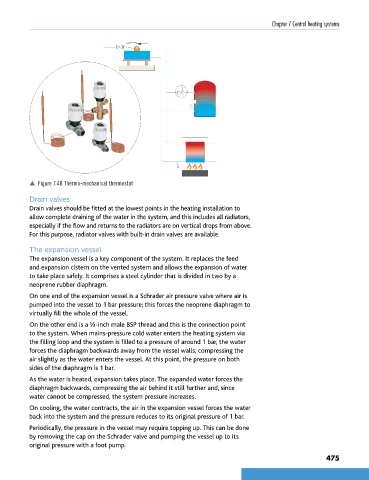
                p  Figure 7.48 Thermo-mechanical thermostat

                Drain valves
                Drain valves should be fitted at the lowest points in the heating installation to
                allow complete draining of the water in the system, and this includes all radiators,
                especially if the flow and returns to the radiators are on vertical drops from above.
                For this purpose, radiator valves with built-in drain valves are available.

                The expansion vessel
                The expansion vessel is a key component of the system. It replaces the feed
                and expansion cistern on the vented system and allows the expansion of water
                to take place safely. It comprises a steel cylinder that is divided in two by a
                neoprene rubber diaphragm.
                On one end of the expansion vessel is a Schrader air pressure valve where air is
                pumped into the vessel to 1 bar pressure; this forces the neoprene diaphragm to
                virtually fill the whole of the vessel.
                On the other end is a ½-inch male BSP thread and this is the connection point
                to the system. When mains-pressure cold water enters the heating system via
                the filling loop and the system is filled to a pressure of around 1 bar, the water
                forces the diaphragm backwards away from the vessel walls, compressing the
                air slightly as the water enters the vessel. At this point, the pressure on both
                sides of the diaphragm is 1 bar.
                As the water is heated, expansion takes place. The expanded water forces the
                diaphragm backwards, compressing the air behind it still further and, since
                water cannot be compressed, the system pressure increases.
                On cooling, the water contracts, the air in the expansion vessel forces the water
                back into the system and the pressure reduces to its original pressure of 1 bar.
                Periodically, the pressure in the vessel may require topping up. This can be done
                by removing the cap on the Schrader valve and pumping the vessel up to its
                original pressure with a foot pump.

                                                                                                                475


        9781510416482.indb   475                                                                                    29/03/19   9:03 PM

