


Page 494 - The City and Guilds Textbook: Plumbing Book 1 for the Level 3 Apprenticeship (9189), Level 2 Technical Certificate (8202) and Level 2 Diploma (6035)
P. 494
The City & Guilds Textbook: Plumbing Book 1


                                                                             Black water at the
                                                                             air release valve
                                                                             when the system
                                                                                 is bled


                                                       Sludge blocks
                                                        boiler heat                                   The sludge is
                                                       exchangers,                                    attracted to
                                                       causing noise                                   circulators

                                                                              The problems
                                                                               of sludging
                                                                                                      Sludge blocks
                                                      Sludge leads to
                                                      the formation of                             pipework, preventing
                                                                                                    the heat getting to
                                                       hydrogen gas
                                                                                                      the radiators


                                                                             The sludge sits at
                                                                              the bottom of
                                                                             radiators, creating
                                                                               cold spots


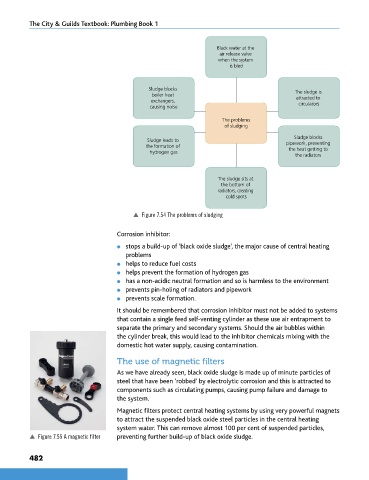
                                                 p  Figure 7.54 The problems of sludging


                                            Corrosion inhibitor:
                                            l  stops a build-up of ‘black oxide sludge’, the major cause of central heating
                                               problems
                                            l  helps to reduce fuel costs
                                            l  helps prevent the formation of hydrogen gas
                                            l  has a non-acidic neutral formation and so is harmless to the environment
                                            l  prevents pin-holing of radiators and pipework
                                            l  prevents scale formation.
                                            It should be remembered that corrosion inhibitor must not be added to systems
                                            that contain a single feed self-venting cylinder as these use air entrapment to
                                            separate the primary and secondary systems. Should the air bubbles within
                                            the cylinder break, this would lead to the inhibitor chemicals mixing with the
                                            domestic hot water supply, causing contamination.

                                            The use of magnetic filters

                                            As we have already seen, black oxide sludge is made up of minute particles of
                                            steel that have been ‘robbed’ by electrolytic corrosion and this is attracted to
                                            components such as circulating pumps, causing pump failure and damage to
                                            the system.

                                            Magnetic filters protect central heating systems by using very powerful magnets
                                            to attract the suspended black oxide steel particles in the central heating
                                            system water. This can remove almost 100 per cent of suspended particles,
                p  Figure 7.55 A magnetic filter  preventing further build-up of black oxide sludge.


                482


        9781510416482.indb   482                                                                                    29/03/19   9:03 PM

