


Page 497 - The City and Guilds Textbook: Plumbing Book 1 for the Level 3 Apprenticeship (9189), Level 2 Technical Certificate (8202) and Level 2 Diploma (6035)
P. 497
Chapter 7 Central heating systems


                2  A standard programmer: these use the same time settings for space heating   KEY POINT
                   and hot water.
                3  A full programmer: allows the time settings for space heating and hot water to   Document L was
                                                                                            implemented to save
                   be fully independent. Some will allow seven-day programming of both heating   energy and power.
                   and hot water so that the two circuits can be used individually or both together.  A great deal of heat
                                                                                            is lost from a building
                Programmers are often fitted to the front fascia of the boiler and integrated into   through not insulating
                the boiler design. This, however, is not always convenient, especially if the boiler   properly and not having
                is sited in a garage or roof space.                                         the necessary controls
                                                                                            on a heating system
                Room thermostats                                                            to prevent the wastage
                                                                                            of fuel. Document L
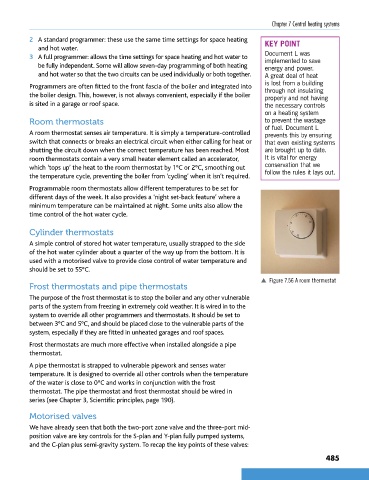
                A room thermostat senses air temperature. It is simply a temperature-controlled   prevents this by ensuring
                switch that connects or breaks an electrical circuit when either calling for heat or   that even existing systems
                shutting the circuit down when the correct temperature has been reached. Most   are brought up to date.
                room thermostats contain a very small heater element called an accelerator,   It is vital for energy
                which ‘tops up’ the heat to the room thermostat by 1°C or 2°C, smoothing out   conservation that we
                the temperature cycle, preventing the boiler from ‘cycling’ when it isn’t required.  follow the rules it lays out.

                Programmable room thermostats allow different temperatures to be set for
                different days of the week. It also provides a ‘night set-back feature’ where a
                minimum temperature can be maintained at night. Some units also allow the
                time control of the hot water cycle.

                Cylinder thermostats

                A simple control of stored hot water temperature, usually strapped to the side
                of the hot water cylinder about a quarter of the way up from the bottom. It is
                used with a motorised valve to provide close control of water temperature and
                should be set to 55°C.
                                                                                           p  Figure 7.56 A room thermostat
                Frost thermostats and pipe thermostats

                The purpose of the frost thermostat is to stop the boiler and any other vulnerable
                parts of the system from freezing in extremely cold weather. It is wired in to the
                system to override all other programmers and thermostats. It should be set to
                between 3°C and 5°C, and should be placed close to the vulnerable parts of the
                system, especially if they are fitted in unheated garages and roof spaces.
                Frost thermostats are much more effective when installed alongside a pipe
                thermostat.
                A pipe thermostat is strapped to vulnerable pipework and senses water
                temperature. It is designed to override all other controls when the temperature
                of the water is close to 0°C and works in conjunction with the frost
                thermostat. The pipe thermostat and frost thermostat should be wired in
                series (see Chapter 3, Scientific principles, page 190).

                Motorised valves

                We have already seen that both the two-port zone valve and the three-port mid-
                position valve are key controls for the S-plan and Y-plan fully pumped systems,
                and the C-plan plus semi-gravity system. To recap the key points of these valves:

                                                                                                                485


        9781510416482.indb   485                                                                                    29/03/19   9:03 PM

