


Page 499 - The City and Guilds Textbook: Plumbing Book 1 for the Level 3 Apprenticeship (9189), Level 2 Technical Certificate (8202) and Level 2 Diploma (6035)
P. 499
Chapter 7 Central heating systems

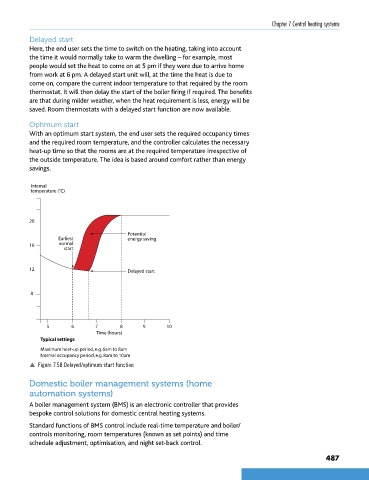
                Delayed start
                Here, the end user sets the time to switch on the heating, taking into account
                the time it would normally take to warm the dwelling – for example, most
                people would set the heat to come on at 5 pm if they were due to arrive home
                from work at 6 pm. A delayed start unit will, at the time the heat is due to
                come on, compare the current indoor temperature to that required by the room
                thermostat. It will then delay the start of the boiler firing if required. The benefits
                are that during milder weather, when the heat requirement is less, energy will be
                saved. Room thermostats with a delayed start function are now available.

                Optimum start
                With an optimum start system, the end user sets the required occupancy times
                and the required room temperature, and the controller calculates the necessary
                heat-up time so that the rooms are at the required temperature irrespective of
                the outside temperature. The idea is based around comfort rather than energy
                savings.

                Internal
                temperature (°C)


                20
                                                Potential
                         Earliest               energy saving
                16       normal
                           start


                12                              Delayed start


                8


                      5       6      7       8       9      10
                                      Time (hours)
                    Typical settings
                    Maximum heat-up period, e.g. 6am to 8am
                    Normal occupancy period, e.g. 8am to 10am
                p  Figure 7.58 Delayed/optimum start function


                Domestic boiler management systems (home
                automation systems)
                A boiler management system (BMS) is an electronic controller that provides
                bespoke control solutions for domestic central heating systems.
                Standard functions of BMS control include real-time temperature and boiler/
                controls monitoring, room temperatures (known as set points) and time
                schedule adjustment, optimisation, and night set-back control.

                                                                                                                487


        9781510416482.indb   487                                                                                    29/03/19   9:03 PM

