


Page 501 - The City and Guilds Textbook: Plumbing Book 1 for the Level 3 Apprenticeship (9189), Level 2 Technical Certificate (8202) and Level 2 Diploma (6035)
P. 501
Chapter 7 Central heating systems
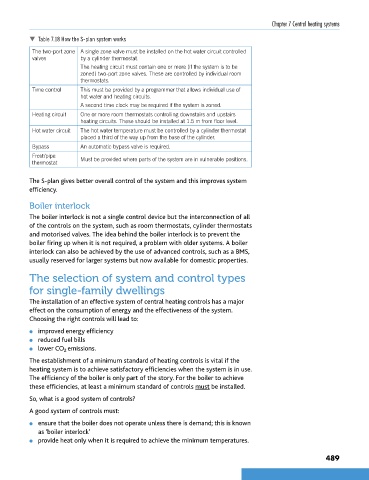
Table 7.18 How the S-plan system works
The two-port zone A single zone valve must be installed on the hot water circuit controlled
valves by a cylinder thermostat.
The heating circuit must contain one or more (if the system is to be
zoned) two-port zone valves. These are controlled by individual room
thermostats.
Time control This must be provided by a programmer that allows individual use of
hot water and heating circuits.
A second time clock may be required if the system is zoned.
Heating circuit One or more room thermostats controlling downstairs and upstairs
heating circuits. These should be installed at 1.5 m from floor level.
Hot water circuit The hot water temperature must be controlled by a cylinder thermostat
placed a third of the way up from the base of the cylinder.
Bypass An automatic bypass valve is required.
Frost/pipe
thermostat Must be provided where parts of the system are in vulnerable positions.
The S-plan gives better overall control of the system and this improves system
efficiency.
Boiler interlock
The boiler interlock is not a single control device but the interconnection of all
of the controls on the system, such as room thermostats, cylinder thermostats
and motorised valves. The idea behind the boiler interlock is to prevent the
boiler firing up when it is not required, a problem with older systems. A boiler
interlock can also be achieved by the use of advanced controls, such as a BMS,
usually reserved for larger systems but now available for domestic properties.
The selection of system and control types
for single-family dwellings
The installation of an effective system of central heating controls has a major
effect on the consumption of energy and the effectiveness of the system.
Choosing the right controls will lead to:
l improved energy efficiency
l reduced fuel bills
l lower CO emissions.
2
The establishment of a minimum standard of heating controls is vital if the
heating system is to achieve satisfactory efficiencies when the system is in use.
The efficiency of the boiler is only part of the story. For the boiler to achieve
these efficiencies, at least a minimum standard of controls must be installed.
So, what is a good system of controls?
A good system of controls must:
l ensure that the boiler does not operate unless there is demand; this is known
as ‘boiler interlock’
l provide heat only when it is required to achieve the minimum temperatures.
489
9781510416482.indb 489 29/03/19 9:03 PM

