


Page 534 - The City and Guilds Textbook: Plumbing Book 1 for the Level 3 Apprenticeship (9189), Level 2 Technical Certificate (8202) and Level 2 Diploma (6035)
P. 534
The City & Guilds Textbook: Plumbing Book 1
PVCu guttering systems
Unplasticised polyvinyl chloride (PVCu) guttering systems are manufactured to
the following British Standards:
l BS EN 607:2004 Eaves gutters and fittings made of PVCu
l BS EN 122001:2000 Plastic rainwater piping systems for above ground
external use.
Most of the guttering systems used on domestic dwellings today are made from
PVCu, the characteristics of which are studied in Chapter 2, Common processes
and techniques.
Table 8.1 The advantages and disadvantages of PVCu as a material for guttering systems
Advantages Disadvantages
It is easy to install It is adversely affected by wood preservatives
It is lightweight and easy to handle It has a greater coefficient of thermal
Minimal maintenance is required expansion (0.06 mm/m/°C) compared to
It requires no painting other materials (see Chapter 3, Scientific
principles)
It does not support combustion It goes brittle in cold temperatures and
It is economical softens at a relatively low temperature
It is corrosion free
It has a smooth internal bore
It has a life expectancy of 50 years
PVCu gutter profiles
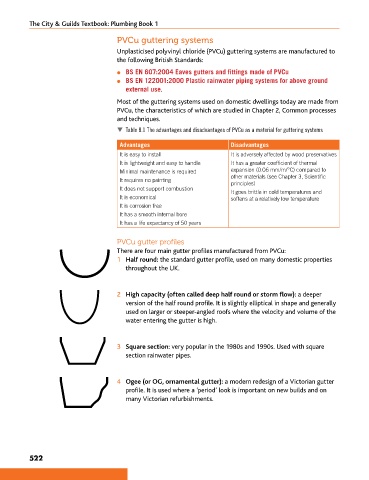
There are four main gutter profiles manufactured from PVCu:
1 Half round: the standard gutter profile, used on many domestic properties
throughout the UK.
2 High capacity (often called deep half round or storm flow): a deeper
version of the half round profile. It is slightly elliptical in shape and generally
used on larger or steeper-angled roofs where the velocity and volume of the
water entering the gutter is high.
3 Square section: very popular in the 1980s and 1990s. Used with square
section rainwater pipes.
4 Ogee (or OG, ornamental gutter): a modern redesign of a Victorian gutter
profile. It is used where a ‘period’ look is important on new builds and on
many Victorian refurbishments.
522
9781510416482.indb 522 29/03/19 9:04 PM

