


Page 537 - The City and Guilds Textbook: Plumbing Book 1 for the Level 3 Apprenticeship (9189), Level 2 Technical Certificate (8202) and Level 2 Diploma (6035)
P. 537
Chapter 8 Rainwater systems
Table 8.3 The advantages and disadvantages of cast iron as a material for guttering systems
Advantages Disadvantages
Strong and durable Installation is expensive and time consuming
Cast iron guttering is expensive
Requires regular painting and maintenance
to prevent corrosion
Heavy
Jointing is time consuming and messy
Jointing cast iron guttering systems
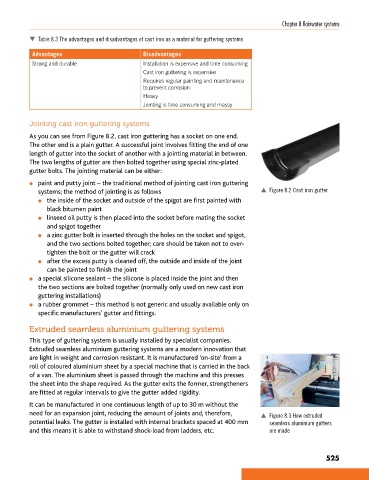
As you can see from Figure 8.2, cast iron guttering has a socket on one end.
The other end is a plain gutter. A successful joint involves fitting the end of one
length of gutter into the socket of another with a jointing material in between.
The two lengths of gutter are then bolted together using special zinc-plated
gutter bolts. The jointing material can be either:
l paint and putty joint – the traditional method of jointing cast iron guttering
systems; the method of jointing is as follows p Figure 8.2 Cast iron gutter
l the inside of the socket and outside of the spigot are first painted with
black bitumen paint
l linseed oil putty is then placed into the socket before mating the socket
and spigot together
l a zinc gutter bolt is inserted through the holes on the socket and spigot,
and the two sections bolted together; care should be taken not to over-
tighten the bolt or the gutter will crack
l after the excess putty is cleaned off, the outside and inside of the joint
can be painted to finish the joint
l a special silicone sealant – the silicone is placed inside the joint and then
the two sections are bolted together (normally only used on new cast iron
guttering installations)
l a rubber grommet – this method is not generic and usually available only on
specific manufacturers’ gutter and fittings.
Extruded seamless aluminium guttering systems
This type of guttering system is usually installed by specialist companies.
Extruded seamless aluminium guttering systems are a modern innovation that
are light in weight and corrosion resistant. It is manufactured ‘on-site’ from a
roll of coloured aluminium sheet by a special machine that is carried in the back
of a van. The aluminium sheet is passed through the machine and this presses
the sheet into the shape required. As the gutter exits the former, strengtheners
are fitted at regular intervals to give the gutter added rigidity.
It can be manufactured in one continuous length of up to 30 m without the
need for an expansion joint, reducing the amount of joints and, therefore, p Figure 8.3 How extruded
potential leaks. The gutter is installed with internal brackets spaced at 400 mm seamless aluminium gutters
and this means it is able to withstand shock-load from ladders, etc. are made
525
9781510416482.indb 525 29/03/19 9:04 PM

