


Page 538 - The City and Guilds Textbook: Plumbing Book 1 for the Level 3 Apprenticeship (9189), Level 2 Technical Certificate (8202) and Level 2 Diploma (6035)
P. 538
The City & Guilds Textbook: Plumbing Book 1
Most companies offer a variety of profiles, including half round and Ogee, in a
variety of colours.
Table 8.4 The advantages and disadvantages of extruded aluminium as a material for guttering
systems
Advantages Disadvantages
Strong and durable An expensive system
Lightweight Does not suit all properties, especially
Long lengths can be installed mid-terraced and town houses where there
are gutters either side
Fewer leaks
A variety of profiles and colours
Minimal thermal expansion
Factors that determine the type and size of
guttering system
A guttering system should have sufficient capacity to carry the expected flow
of water at any point on the system. When designing a guttering system for
a dwelling, there are factors that must be considered if the system is to cope
comfortably with the rain that falls on the roof surface. The actual flow in the
system depends on the area to be drained, the rainfall intensity and the position
of the rainwater outlets.
In this section, we will look at the design factors that enable us to install
effective guttering systems. These are:
l rainfall intensity
l roof area
l running outlet position
l the fall of the gutter
l changes of direction in the gutter run.
Rainfall intensity
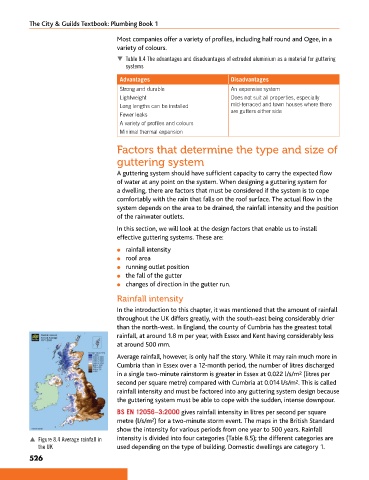
In the introduction to this chapter, it was mentioned that the amount of rainfall
throughout the UK differs greatly, with the south-east being considerably drier
than the north-west. In England, the county of Cumbria has the greatest total
rainfall, at around 1.8 m per year, with Essex and Kent having considerably less
at around 500 mm.
Average rainfall, however, is only half the story. While it may rain much more in
Cumbria than in Essex over a 12-month period, the number of litres discharged
in a single two-minute rainstorm is greater in Essex at 0.022 l/s/m (litres per
2
second per square metre) compared with Cumbria at 0.014 l/s/m . This is called
2
rainfall intensity and must be factored into any guttering system design because
the guttering system must be able to cope with the sudden, intense downpour.
BS EN 12056–3:2000 gives rainfall intensity in litres per second per square
2
metre (l/s/m ) for a two-minute storm event. The maps in the British Standard
show the intensity for various periods from one year to 500 years. Rainfall
p Figure 8.4 Average rainfall in intensity is divided into four categories (Table 8.5); the different categories are
the UK used depending on the type of building. Domestic dwellings are category 1.
526
9781510416482.indb 526 29/03/19 9:04 PM

