


Page 539 - The City and Guilds Textbook: Plumbing Book 1 for the Level 3 Apprenticeship (9189), Level 2 Technical Certificate (8202) and Level 2 Diploma (6035)
P. 539
Chapter 8 Rainwater systems
Table 8.5 Categories of rainfall intensity
Cat. 1 Return period of 1 year Eaves gutters and flat roofs INDUSTRY TIP
Cat. 2 Return period of 1.5 × design life of the Valley and parapet gutters for normal
building buildings The British Geological Survey
Cat. 3 Return period of 4.5 × design life of the Valley and parapet gutters for higher- website provides useful maps
building risk buildings of rainfall in the UK, accessed
Cat. 4 Maximum probable rainfall Highest-risk buildings at: www.bgs.ac.uk/data/
mapViewers/home.html
Roof area
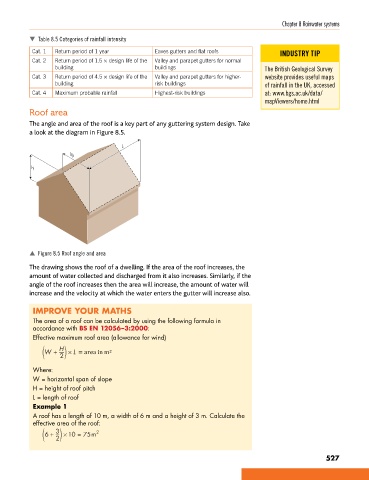
The angle and area of the roof is a key part of any guttering system design. Take
a look at the diagram in Figure 8.5.
L
W
H
p Figure 8.5 Roof angle and area
The drawing shows the roof of a dwelling. If the area of the roof increases, the
amount of water collected and discharged from it also increases. Similarly, if the
angle of the roof increases then the area will increase, the amount of water will
increase and the velocity at which the water enters the gutter will increase also.
IMPROVE YOUR MATHS
The area of a roof can be calculated by using the following formula in
accordance with BS EN 12056–3:2000:
Effective maximum roof area (allowance for wind)
( W + H ) × L = area in m 2
2
Where:
W = horizontal span of slope
H = height of roof pitch
L = length of roof
Example 1
A roof has a length of 10 m, a width of 6 m and a height of 3 m. Calculate the
effective area of the roof:
( ) × 10 =75m 2
3
6
+
2
527
9781510416482_Ch8.indd 527 01/04/19 9:37 PM

