


Page 564 - The City and Guilds Textbook: Plumbing Book 1 for the Level 3 Apprenticeship (9189), Level 2 Technical Certificate (8202) and Level 2 Diploma (6035)
P. 564
The City & Guilds Textbook: Plumbing Book 1


                 ACTIVITY
                 The gradient curve
                 Try the gradient curve for
                 yourself. Determine the
                 answers to the following
                 questions:
                 1  A waste pipe has a       Invert of
                    length of 1.5 m. What    the drain
                    is its gradient?                      450 mm for low-rise buildings
                 2  A waste pipe has a                    750mm minimum for multi-
                    length of 750 mm.                     storey buildings
                    What is its gradient?   p  Figure 9.3 Branch connections at the invert of the drain
                 3  A waste pipe has a
                    gradient of 120 mm/m.   Bends and off-sets
                    What is its length?
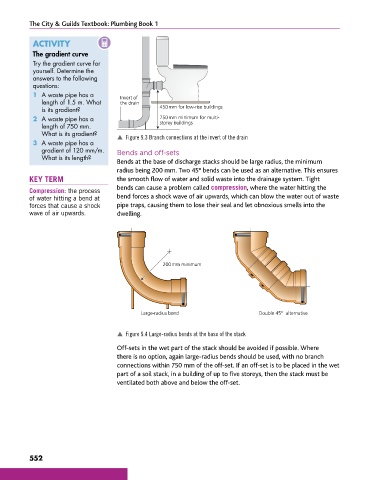
                                            Bends at the base of discharge stacks should be large radius, the minimum
                                            radius being 200 mm. Two 45° bends can be used as an alternative. This ensures
                KEY TERM                    the smooth flow of water and solid waste into the drainage system. Tight
                                            bends can cause a problem called compression, where the water hitting the
                Compression: the process
                of water hitting a bend at   bend forces a shock wave of air upwards, which can blow the water out of waste
                forces that cause a shock   pipe traps, causing them to lose their seal and let obnoxious smells into the
                wave of air upwards.        dwelling.


                                                           200mm minimum


                                                    Large-radius bend                     Double 45°  alternative

                                            p  Figure 9.4 Large-radius bends at the base of the stack

                                            Off-sets in the wet part of the stack should be avoided if possible. Where
                                            there is no option, again large-radius bends should be used, with no branch
                                            connections within 750 mm of the off-set. If an off-set is to be placed in the wet
                                            part of a soil stack, in a building of up to five storeys, then the stack must be
                                            ventilated both above and below the off-set.


                552


        9781510416482.indb   552                                                                                    29/03/19   9:05 PM

