


Page 567 - The City and Guilds Textbook: Plumbing Book 1 for the Level 3 Apprenticeship (9189), Level 2 Technical Certificate (8202) and Level 2 Diploma (6035)
P. 567
Chapter 9 Sanitation systems

                The ventilated branch discharge system is used on larger systems where there is
                a risk of trap seal loss because the waste pipe lengths are excessive. Control of
                the pressure in the waste pipe (the discharge branch) is achieved by ventilating
                it no further than 750 mm from the appliance as this safeguards against trap
                seal loss by induced or self-siphonage. Alternatively, small air admittance valves
                may be used at each appliance. These allow air into the system when the
                appliance is in operation.

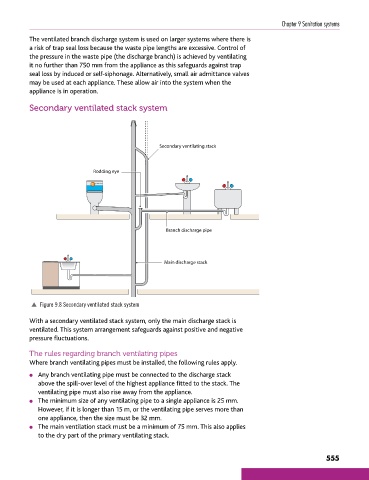
                Secondary ventilated stack system


                                                          Secondary ventilating stack


                                     Rodding eye


                                                            Branch discharge pipe


                                                            Main discharge stack


                p  Figure 9.8 Secondary ventilated stack system

                With a secondary ventilated stack system, only the main discharge stack is
                ventilated. This system arrangement safeguards against positive and negative
                pressure fluctuations.

                The rules regarding branch ventilating pipes
                Where branch ventilating pipes must be installed, the following rules apply.
                ●  Any branch ventilating pipe must be connected to the discharge stack
                   above the spill-over level of the highest appliance fitted to the stack. The
                   ventilating pipe must also rise away from the appliance.
                ●  The minimum size of any ventilating pipe to a single appliance is 25 mm.
                   However, if it is longer than 15 m, or the ventilating pipe serves more than
                   one appliance, then the size must be 32 mm.
                ●  The main ventilation stack must be a minimum of 75 mm. This also applies
                   to the dry part of the primary ventilating stack.


                                                                                                                555


        9781510416482.indb   555                                                                                    29/03/19   9:05 PM

