


Page 593 - The City and Guilds Textbook: Plumbing Book 1 for the Level 3 Apprenticeship (9189), Level 2 Technical Certificate (8202) and Level 2 Diploma (6035)
P. 593
Chapter 9 Sanitation systems

                Tubular traps

                Tubular traps can take several different forms.


                                             INDUSTRY TIP

                 ‘P’ traps and ‘S’ traps are named after their shape. A ‘P’ trap is used where the waste
                 pipe is installed from the appliance horizontally, directly through the wall and into a gulley
                 or stack. The ‘S’ trap, because of its shape, will allow pipework to be installed vertically
                 downwards from the trap into a waste pipe serving a number of appliances or into an
                 underfloor waste pipe.


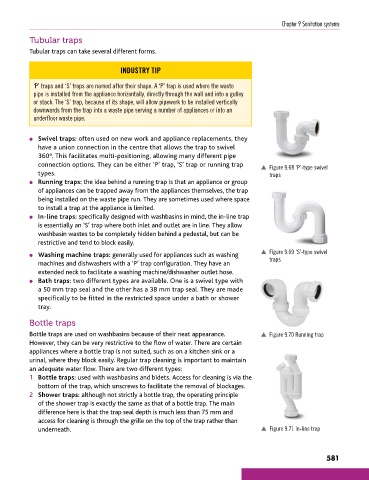
                ●  Swivel traps: often used on new work and appliance replacements, they
                   have a union connection in the centre that allows the trap to swivel
                   360°. This facilitates multi-positioning, allowing many different pipe
                   connection options. They can be either ‘P’ trap, ‘S’ trap or running trap   p  Figure 9.68 ‘P’-type swivel
                   types.                                                                     traps
                ●  Running traps: the idea behind a running trap is that an appliance or group
                   of appliances can be trapped away from the appliances themselves, the trap
                   being installed on the waste pipe run. They are sometimes used where space
                   to install a trap at the appliance is limited.
                ●  In-line traps: specifically designed with washbasins in mind, the in-line trap
                   is essentially an ‘S’ trap where both inlet and outlet are in line. They allow
                   washbasin wastes to be completely hidden behind a pedestal, but can be
                   restrictive and tend to block easily.
                                                                                           p  Figure 9.69 ‘S’-type swivel
                ●  Washing machine traps: generally used for appliances such as washing       traps
                   machines and dishwashers with a ‘P’ trap configuration. They have an
                   extended neck to facilitate a washing machine/dishwasher outlet hose.
                l  Bath traps: two different types are available. One is a swivel type with
                   a 50 mm trap seal and the other has a 38 mm trap seal. They are made
                   specifically to be fitted in the restricted space under a bath or shower
                   tray.

                Bottle traps
                Bottle traps are used on washbasins because of their neat appearance.      p  Figure 9.70 Running trap
                However, they can be very restrictive to the flow of water. There are certain
                appliances where a bottle trap is not suited, such as on a kitchen sink or a
                urinal, where they block easily. Regular trap cleaning is important to maintain
                an adequate water flow. There are two different types:
                1  Bottle traps: used with washbasins and bidets. Access for cleaning is via the
                   bottom of the trap, which unscrews to facilitate the removal of blockages.
                2  Shower traps: although not strictly a bottle trap, the operating principle
                   of the shower trap is exactly the same as that of a bottle trap. The main
                   difference here is that the trap seal depth is much less than 75 mm and
                   access for cleaning is through the grille on the top of the trap rather than
                   underneath.                                                             p  Figure 9.71 In-line trap


                                                                                                                581


        9781510416482.indb   581                                                                                    29/03/19   9:07 PM

