


Page 594 - The City and Guilds Textbook: Plumbing Book 1 for the Level 3 Apprenticeship (9189), Level 2 Technical Certificate (8202) and Level 2 Diploma (6035)
P. 594
The City & Guilds Textbook: Plumbing Book 1

                                            Anti-vac and resealing (anti-siphon) traps

                                            There is no substitute for a well-planned, well-designed system of sanitary
                                            pipework. If the system is designed in accordance with BS EN 12056, then
                                            problems with trap seal loss should not occur. Anti-vac (anti-vacuum) and
                                            resealing traps are not an alternative to a good sanitary pipework system, but
                                            they can reduce the problems that occur with existing systems due to upgrades
                                            to appliances and additions to the system.

                                            Anti-vac (anti-vacuum) traps

                                            Anti-vac traps use a small air admittance valve that is located after the water
                p  Figure 9.72 Washing machine   seal. The valve opens if a drop in pressure occurs when the appliance is used,
                   trap
                                            and this allows air into the system to break any siphonic action that may
                                            occur.
                      INDUSTRY TIP
                                            Resealing traps
                 Fitting an anti-vac trap is not
                 recommended on new systems   Externally, resealing traps are identical to a normal bottle trap. Internally,
                 as they have a habit of not   however, they are quite different: the trap has a bypass within the body of the
                 holding an air test at the   bottle trap, allowing air to enter the trap, via a dip pipe, in the event of siphonic
                 installation and testing stage.  action occurring. They are available only as a bottle trap and so are not suitable
                                            for all installation situations.

                                            Self-sealing traps

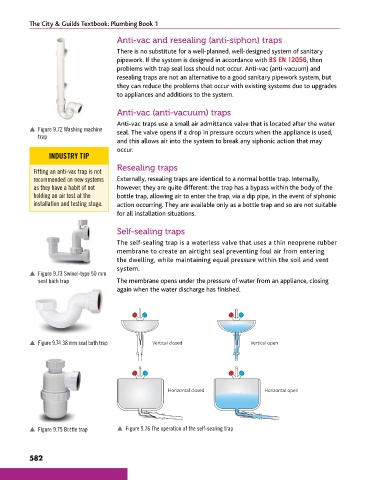
                                            The self-sealing trap is a waterless valve that uses a thin neoprene rubber
                                            membrane to create an airtight seal preventing foul air from entering
                                            the dwelling, while maintaining equal pressure within the soil and vent
                                            system.
                p  Figure 9.73 Swivel-type 50 mm
                   seal bath trap           The membrane opens under the pressure of water from an appliance, closing
                                            again when the water discharge has finished.


                p  Figure 9.74 38 mm seal bath trap     Vertical closed                Vertical open


                                                             Horizontal closed              Horizontal open


                p  Figure 9.75 Bottle trap  p  Figure 9.76 The operation of the self-sealing trap


                582


        9781510416482.indb   582                                                                                    29/03/19   9:07 PM

