


Page 596 - The City and Guilds Textbook: Plumbing Book 1 for the Level 3 Apprenticeship (9189), Level 2 Technical Certificate (8202) and Level 2 Diploma (6035)
P. 596
The City & Guilds Textbook: Plumbing Book 1

                                            Reasons for loss of tap/trap seal
                                            There are various ways in which tap/trap seal loss occurs:

                                            ●  self-siphonage
                                            ●  induced siphonage
                                            ●  compression
                                            ●  wavering out
                                            ●  evaporation
                                            ●  capillary attraction
                                            ●  momentum
                                            ●  foaming.

                                            Self-siphonage
                      INDUSTRY TIP
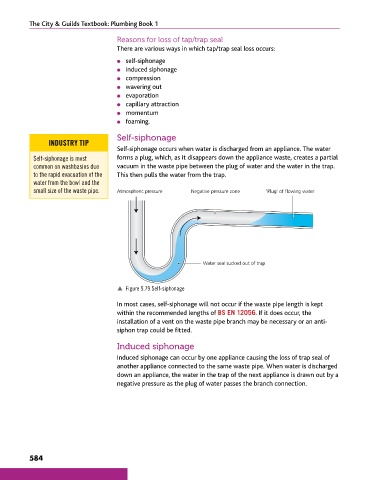
                                            Self-siphonage occurs when water is discharged from an appliance. The water
                 Self-siphonage is most     forms a plug, which, as it disappears down the appliance waste, creates a partial
                 common on washbasins due   vacuum in the waste pipe between the plug of water and the water in the trap.
                 to the rapid evacuation of the   This then pulls the water from the trap.
                 water from the bowl and the
                 small size of the waste pipe.  Atmospheric pressure  Negative pressure zone  'Plug' of flowing water


                                                                        Water seal sucked out of trap


                                            p  Figure 9.79 Self-siphonage

                                            In most cases, self-siphonage will not occur if the waste pipe length is kept
                                            within the recommended lengths of BS EN 12056. If it does occur, the
                                            installation of a vent on the waste pipe branch may be necessary or an anti-
                                            siphon trap could be fitted.

                                            Induced siphonage

                                            Induced siphonage can occur by one appliance causing the loss of trap seal of
                                            another appliance connected to the same waste pipe. When water is discharged
                                            down an appliance, the water in the trap of the next appliance is drawn out by a
                                            negative pressure as the plug of water passes the branch connection.


                584


        9781510416482.indb   584                                                                                    29/03/19   9:07 PM

