


Page 595 - The City and Guilds Textbook: Plumbing Book 1 for the Level 3 Apprenticeship (9189), Level 2 Technical Certificate (8202) and Level 2 Diploma (6035)
P. 595
Chapter 9 Sanitation systems


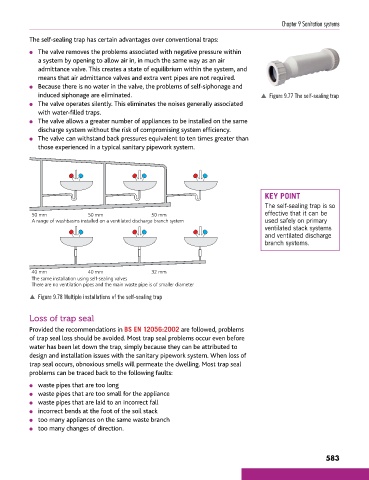
                The self-sealing trap has certain advantages over conventional traps:
                ●  The valve removes the problems associated with negative pressure within
                   a system by opening to allow air in, in much the same way as an air
                   admittance valve. This creates a state of equilibrium within the system, and
                   means that air admittance valves and extra vent pipes are not required.
                ●  Because there is no water in the valve, the problems of self-siphonage and
                   induced siphonage are eliminated.                                       p  Figure 9.77 The self-sealing trap
                ●  The valve operates silently. This eliminates the noises generally associated
                   with water-filled traps.
                ●  The valve allows a greater number of appliances to be installed on the same
                   discharge system without the risk of compromising system efficiency.
                ●  The valve can withstand back pressures equivalent to ten times greater than
                   those experienced in a typical sanitary pipework system.


                                                                                            KEY POINT
                                                                                            The self-sealing trap is so
                 50 mm             50 mm               50 mm                                effective that it can be
                 A range of washbasins installed on a ventilated discharge branch system    used safely on primary
                                                                                            ventilated stack systems
                                                                                            and ventilated discharge
                                                                                            branch systems.


                 40 mm             40 mm               32 mm
                 The same installation using self-sealing valves
                 There are no ventilation pipes and the main waste pipe is of smaller diameter

                p  Figure 9.78 Multiple installations of the self-sealing trap


                Loss of trap seal
                Provided the recommendations in BS EN 12056:2002 are followed, problems
                of trap seal loss should be avoided. Most trap seal problems occur even before
                water has been let down the trap, simply because they can be attributed to
                design and installation issues with the sanitary pipework system. When loss of
                trap seal occurs, obnoxious smells will permeate the dwelling. Most trap seal
                problems can be traced back to the following faults:
                ●  waste pipes that are too long
                ●  waste pipes that are too small for the appliance
                ●  waste pipes that are laid to an incorrect fall
                ●  incorrect bends at the foot of the soil stack
                ●  too many appliances on the same waste branch
                ●  too many changes of direction.


                                                                                                                583


        9781510416482.indb   583                                                                                    29/03/19   9:07 PM

