


Page 76 - The City and Guilds Textbook: Plumbing Book 1 for the Level 3 Apprenticeship (9189), Level 2 Technical Certificate (8202) and Level 2 Diploma (6035)
P. 76
The City & Guilds Textbook: Plumbing Book 1

                                            Ladder safety check before use

                                            Ladders, roof ladders and crawlboards should NOT be used if they have any of
                                            the following defects:
                                            ●  broken, missing or makeshift rungs
                                            ●  broken, weakened or repaired stiles
                                            ●  broken or defective ropes, guide brackets, latching hooks or pulley wheels
                                            ●  they are painted; paint can hide defects on wooden ladders
                                            ●  they have missing safety feet.

                                            Raising and lowering ladders
                                            Ladders should be raised with the sections closed. Extension ladders with long
                                            sections should be raised one section at a time and slotted into position before
                                            the ladders are used. TWO people are required to raise and lower heavier-type
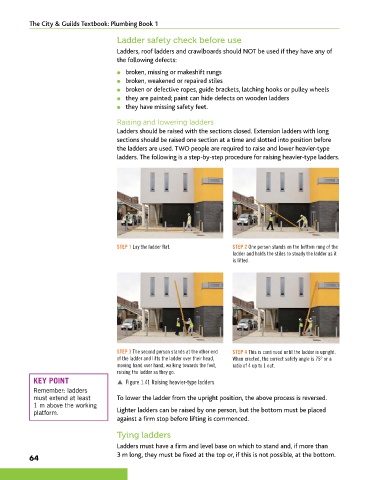
                                            ladders. The following is a step-by-step procedure for raising heavier-type ladders.


                                            STEP 1 Lay the ladder flat.           STEP 2 One person stands on the bottom rung of the
                                                                                  ladder and holds the stiles to steady the ladder as it
                                                                                  is lifted.


                                            STEP 3 The second person stands at the other end   STEP 4 This is continued until the ladder is upright.
                                            of the ladder and lifts the ladder over their head,   When erected, the correct safety angle is 75° or a
                                            moving hand over hand, walking towards the foot,   ratio of 4 up to 1 out.
                                            raising the ladder as they go.
                 KEY POINT                  p  Figure 1.41 Raising heavier-type ladders
                 Remember: ladders
                 must extend at least       To lower the ladder from the upright position, the above process is reversed.
                 1 m above the working
                 platform.                  Lighter ladders can be raised by one person, but the bottom must be placed
                                            against a firm stop before lifting is commenced.

                                            Tying ladders

                                            Ladders must have a firm and level base on which to stand and, if more than
                64                          3 m long, they must be fixed at the top or, if this is not possible, at the bottom.


        9781510416482.indb   64                                                                                     29/03/19   8:50 PM

