


Page 75 - The City and Guilds Textbook: Plumbing Book 1 for the Level 3 Apprenticeship (9189), Level 2 Technical Certificate (8202) and Level 2 Diploma (6035)
P. 75
Chapter 1 Health and safety practices and systems


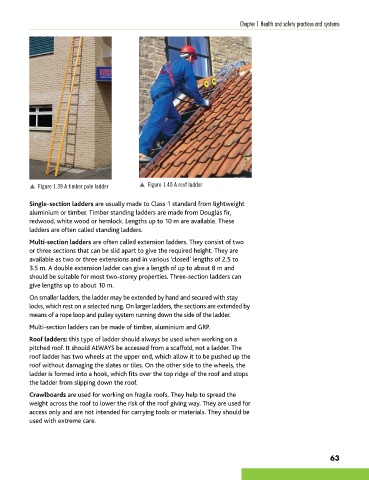
                p  Figure 1.39 A timber pole ladder  p  Figure 1.40 A roof ladder


                Single-section ladders are usually made to Class 1 standard from lightweight
                aluminium or timber. Timber standing ladders are made from Douglas fir,
                redwood, white wood or hemlock. Lengths up to 10 m are available. These
                ladders are often called standing ladders.

                Multi-section ladders are often called extension ladders. They consist of two
                or three sections that can be slid apart to give the required height. They are
                available as two or three extensions and in various ‘closed’ lengths of 2.5 to
                3.5 m. A double extension ladder can give a length of up to about 8 m and
                should be suitable for most two-storey properties. Three-section ladders can
                give lengths up to about 10 m.

                On smaller ladders, the ladder may be extended by hand and secured with stay
                locks, which rest on a selected rung. On larger ladders, the sections are extended by
                means of a rope loop and pulley system running down the side of the ladder.

                Multi-section ladders can be made of timber, aluminium and GRP.
                Roof ladders: this type of ladder should always be used when working on a
                pitched roof. It should ALWAYS be accessed from a scaffold, not a ladder. The
                roof ladder has two wheels at the upper end, which allow it to be pushed up the
                roof without damaging the slates or tiles. On the other side to the wheels, the
                ladder is formed into a hook, which fits over the top ridge of the roof and stops
                the ladder from slipping down the roof.
                Crawlboards are used for working on fragile roofs. They help to spread the
                weight across the roof to lower the risk of the roof giving way. They are used for
                access only and are not intended for carrying tools or materials. They should be
                used with extreme care.


                                                                                                                 63


        9781510416482.indb   63                                                                                     29/03/19   8:50 PM

