


Page 109 - APPLIED PROCESS DESIGN FOR CHEMICAL AND PETROCHEMICAL PLANTS, Volume 1, 3rd Edition
P. 109
Fluid Flow                                            93

                Correction  Factors                                   Factors tO  consider in evaluating the control valve  pres-
                Volur of  C        60  70  80  90  100  110  120  130  140   sure drop are:
                Multi  lier  to  Correct  Chart 2.57  1.93  1.50  1.22  1.0  .84  .71  .62  .54
                                                                      A Allowance for increase in friction  drop


                                                                    Establish  the  ratio  of the  maximum  antir:ipated  flow  rate
                                                                    for system, QM,  to  the design basis rate,  Q or QM/Q .
                                                                                                          0
                                                                                                                    0
                                                                    When  Q:vr  is  not known,  nor can  it be  anticipated,  use:
                                                                    Q.,1/Q0 of 1.1 for flow control and 1.25 for level  pressure
                                                                    and temperature control valves to  anticipate  the flow rate
                                                                    transients  as  the  control  loop  recovers  from  a  distur-
                                                                    bance  [9J.
                                                                      At  the  maximum  flow  rate  QM,  the  friction  drop  will
                                                                    become:

                 I                                                                                               (2-62)
                 IL
                                                                      The  increase in pressure  drop will  be:

                                                                                                                 (2-63)
                       1--  ....  � <!l.,,. � '4-"°+-l-++l. � /:.-l   c;,i.t.\   \  .�   \
                      3 I/  [...,'   \   �\�  '   �   . y                                                        (2-64)
                      2v � vv""   �  K  J,.t,.  \�
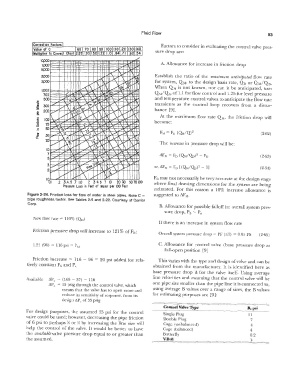
                     1.q,L _ l___.::t: . 2.....L . 3.l:4..J . 5...:1.. . 7u.l.1.. . 0 � ..1.2£..L.3...14_J5...J....::7LLI- 1 0-2.i..o-30::':-'-'50 � 70'."" I OO   F0 may not necessarily be very accurate at the design stage
                                                                   where final drawing dimensions for the  system  are  being
                            Pressure  Loss  in  Feet  of  Water  per  100 Feet
                                                                   estimated.  For  this  reason  a  10%  increase  allowance  is
             Figure 2-24.  Friction  loss for flow of water in steel  pipes.  Note C  =   suggested to £\FM.
             pipe roughness factor.  See Tables 2-9 and 2-22.  Courtesy of Carrier
             Corp.
                                                                      B.  Allowance for possible falloff in:  overall system pres-
                                                                        sure drop, P5  - Pe
                New flow rate =  110%  (Q 0)
                                                                     If there is an  increase in system  flow rate
                                                         F
                Friction pressure drop will increase to  121 %  of  0;
                                                                     Overall  system  pressure drop  =  PF (all)  = 0.05 PS   (2-65)
                1.21  (96)  =  116 psi  =  FM                        C.  Allowance  for control  valve  (base  pressure  drop   at
                                                                        full-open position  [9J
                Friction  increase  =c  116 - 96  = 0  20  psi  added for rela-   This varies with  the type and design of valve and can be
             tively constant Ps and P.,
                                                                   obtained  from  the manufacturer.  It is  identified  here  as
                                                                   base  pressure  drop  B  for  the  valve  itself.  Using  average
             Available   �pc= (168  - 37)  - 116                   line velocities and assuming  that the control valve will  be
                      �Pc  =  15 psig through the control valve, which   one pipe size smaller than the pipe line it is connected to,
                            means that the valve has to  open  more and   using average B  values  over a  range  of sizes,  the B values
                            reduce its sensitivity of response,  from its   for estimating purposes are  [9]:
                            design �pc of 35  psig
                                                                       Control Valve Type                  B,p_s_ i __
             For design  purposes,  the assumed 35  psi  for the  control
             valve could be used; however,  decreasing the  pipe  friction   Single Plug                    11
                                                                       Double  Plug
                                                                                                            7
             of 6  psi  to  perhaps X  or Y.  by  increasing  the  line size will   Cage  (unbalanced)      4
             help  the control  of the valve.  It would  be  better to  have   Cage  (balanced)             4
             the  available valve  pressure drop equal  to or  greater  than   Butterfly                    0.2
             the assumed.                                              V-Ball                               l

