


Page 216 - APPLIED PROCESS DESIGN FOR CHEMICAL AND PETROCHEMICAL PLANTS, Volume 1, 3rd Edition
P. 216
186                       Applied  Process Design for Chemical  and Petrochemical  Plants

             es are a function of the characteristics of the fluid flowing
             in the  piping systems and  the velocities of flow.  Entrance
             and  exit losses  relate  to  the  pipe  and  not the  suction or
             discharge connections at the pump.  Usually they are very            s
             small,  but cannot be  ignored  without checking.  Velocity
             heads  at  the  pump  connections  are  considered internal
             losses. These are handled by the manufacturer's design of              Pump
             the pump and are not considered with the external losses
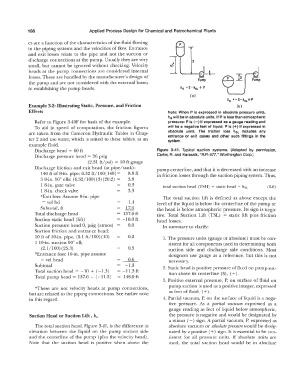
             in establishing the pump heads.                                 h5  =  S-  hSL + p
                                                                                 (al
                                                                                                 h5  �-s-hSL+P
             Example 3-2: Illustrating Static,  Pressure, and Friction                               (bl
             Effects                                                    Note:  When  P  is expressed  In  absolute  pressure units,
                                                                        hs will be in absolute units. If P Is less than atmospheric
                Refer to Figure 3-40F for basis of the example.         pressure:  Pis(-) If expressed as a gauge  reading and
                To  aid  in  speed  of computation,  the  friction  figures   will  be a negative feet of liquid.  P  Is(+) If expressed In
                                                                        absolute  units.  The  friction  loss  hsL  Includes  any
             are  taken  from  the  Cameron  Hydraulic  Tables  in  Chap-   entrance  or  exit losses  and  other  such  fittings  in  the
             ter 2  and use water,  which is suited  to  these  tables,  as  an   system.
             example fluid.
                Discharge  head =  60 ft                           Figure  3-41.  Typical  suction  systems.  (Adapted  by  permission,
                Discharge pressure head =  26 psig                 Carter,  A.  and Karassik,  "A.P.-477." Worthington Corp.)
                                      (2.31  ft/psi)  =  60 ft gauge
                Discharge friction and exit head  (at pipe/tank):   pump centerline, and that it is decreased with an increase
                  140 ft of 8-in.  pipe:  6.32 ft/100(140) =   8.8 ft   in friction losses through the suction piping system. Thus,
                  3  8-in.  goo  ells:  (6.32/100)(3)(20.2)   3.8
                  1  8-iu.  gate valve                 0.3           total suction head  (TSH)  = static head  - hsL   (3-6)
                  1  8-in.  check valve                3.3
                  *Exit loss:  Assume 8-in.  pipe                    The  total  suction  lift  is  defined  as  above  except  the
                   = vel hd                            1.4         level of the liquid is below the centerline of the pump or
                  Subtotal,  ft                       17.6         the head is  below atmospheric pressure.  Its  sign is nega-
                Total discharge head                 137.6 ft      tive.  Total  Suction  Lift  (TSL)  =  static  lift  plus  friction
                Suction static head  (lift)       =  -10.0 ft      head losses.
                Suction  pressure head 0,  psig  (atmos)   0.0       In summary to  clarify:
                Suction friction and entrance head:
                10 ft of 10-in.  pipe,  (2.1  ft/100) (10)   0.2      1. The pressure units  (gauge or absolute)  must be con-
                1  l 0-in.  suction  go 0   ell;                        sistent for all components used in determining both
                  (2.l/100) (25.3)                     0.5              suction  side  and  discharge  side  conditions.  Most
                *En  trance loss:  l 0-in.  pipe assume                 designers  use  gauge  as  a  reference,  but  this  is  not
                  = vel  head                          0.6              necessary.
                Subtotal                              -1.3            2.  Static head is  positive pressure of  fluid on pump suc-
                Total suction head =  - 10 +  (-1.3)   =  -11.3 ft      tion above its centerline  (S), ( +).
                Total  pump head  r=  137.6 - (-11.3)   =  148.9ft
                                                                      3. Positive  external  pressure,  P,  on  surface of fluid on
                *These  are  not velocity  heads  at  pump  connections,   pump suction is used as a positive integer,  expressed
             but are related to the piping connections. See earlier note   as feet of fluid,  ( +).
             in this regard.                                          4.  Partial vacuum, P,  on  the surface of liquid is a  nega-
                                                                        tive  pressure.  As  a  partial  vacuum  expressed  as  a
                                                                        gauge  reading as  feet of liquid below  atmospheric,
             Suction Head or Suction Lift ,  h,                         the pressure is negative and would be designated by
                                                                        a minus  (-)  sign. A partial  vacuum,  P,  expressed as
                The total suction head, Figure 3-41, is the difference in   absolute vacuum or absolute pressure would be desig-
             elevation  between  the  liquid  on  the  pump  suction  side   nated by a positive  ( +)  sign.  It is essential to be con-
             and the centerline of the pump  (plus the velocity  head).   sistent for  all  pressure  units.  If absolute  units  are
             Note  that  the  suction  head  is  positive  when  above  the   used,  the  total  suction  head would  be  in  absolute

