


Page 217 - APPLIED PROCESS DESIGN FOR CHEMICAL AND PETROCHEMICAL PLANTS, Volume 1, 3rd Edition
P. 217
Pumping of Liquids                                       187

               units  and the discharge  head must be calculated in   Discharge Head, hd
               absolute units.
             5.  Suction lift is a negative suction head, S,  used lo des-   The discharge head of a pump is the head measured at
               ignate  a  negative  static  condition on  the  suction  of   the  discharge  nozzle  (gauge  or  absolute),  and  is  com-
               the pump (below atmospheric). The sign for suction   posed of the same basic factors previously summarized;  1.
               head  is  positive  ( +), while  its  corresponding  termi-   static  head  2.  friction  losses  through  pipe,  fittings,  con-
               nology of suction lift is negative  (-), since the  term   tractions,  expansions,  entrances and exits  3.  terminal  sys-
               "lift" denotes a negative condition. Note that the only   tem  pressure.
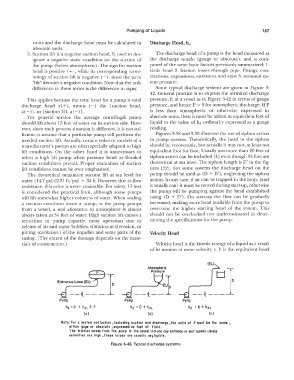
               difference in these terms is  the difference in signs.   Some  typical discharge  systems  are  given  in  Figure  3-
                                                                42.  General  practice  is  to  express  the  terminal  discharge
            This applies because the total  head for a pump is total   pressure, P,  at a vessel  as in Figure 3-42  in terms of gauge
          discharge  head  a(+),  minus  (-)  the  [suction  head,   pressure, and hence P  = 0 for atmospheric discharge.  If P
          a(+)], or [suction lift,  a(-)].                      is  less  than  atmospheric  or  otherwise  expressed  in
             For  general  service  the  average  centrifugal  pump   absolute units,  then it must be added as equivalent feet of
          should lift about 15 feet of  water on its suction side. How-   liquid  to  the value  of hd  ordinarily  expressed as  a  gauge
          ever,  since each  process situation is different,  it is not suf-   reading.
          ficient to assume that  a  particular pump will perform  the   Figures 3-38 and 3-39 illustrate the use of  siphon action
          needed suction lift.  Actually,  certain styles or mode  is of a   in  pump  systems.  Theoretically,  the  head  in  the  siphon
          manufacturer's pumps are often specially adapted to high   should be recoverable, but actually it may not,  at least not
          lift  conditions.  On  the  other  hand  it  is  unnecessary  to   equivalent foot for foot.  Usually not more  than 20 feet of
          select  a  high  lift  pump  when  pressure  head  or  flooded   siphon action can be included [ 4]  even though 34 feet are
          suction  conditions  prevail.  Proper evaluation  of suction   theoretical at sea level. The siphon length is D' in the fig-
          lift  conditions cannot be over emphasized.           ures  [32]. For some  systems  the  discharge  head  on  the
             The  theoretical  maximum  suction  lift  at sea  level for   pump should be used as  (D  +  D'), neglecting the siphon
          water (14.7 psi) (2.31  ft/psi)  =  34 ft.  However,  due to flow   action. In any case, if air can be trapped in the loop,  (and
          resistance,  this value is never attainable. For safety,  15 feet   it usually can)  it must be vented during start-up, otherwise
          is  considered  the  practical  limit,  although  some  pumps   the  pump will  be  pumping against the  head  established
          will lift  somewhat higher columns of water.  When sealing   using  (D  +  D').  On  start-up  the  flow  can  be  gradually
          a vacuum  condition  above  a  pump,  or the pump  pumps   increased,  making more head available from the pump to
          from  a  vessel,  a  seal  allowance  to  atmosphere  is  almost   overcome  the  higher  starting  head  of the  system.  This
          always taken as 34 feet of  water.  High  suction  lift causes a   should  not be  overlooked nor underestimated  in deter-
          reduction  in  pump  capacity,  noisy  operation  due  to   mining the specifications for the pump.
          release of air and vapor bubbles, vibration and erosion, or
          pitting  (cavitation)  of the impeller and some parts of the   Velocity Head
          casing.  (The extent of the damage depends on  the mate-
          rials of construction.)                                 Velocity head is the kinetic energy of a liquid as a result
                                                                of its  motion at some velocity,  v.  It is  the equivalent head


                                                                                        (EL)
                                                               Atmospheric
                                                                Pressure
                                    (:  __
                         Entran::             }           -·-t-·-·t               --t- t::l1


                          Pump                       Pump                     Pump
                             hd  : D  +  hdL +  p       hd  =  D  +  hdL        hd  :  D  +  hdL
                                    (al                        (bl                       (cl
                           Note: '.or  a  system  evaluation,  includino  suction  and  discharge,  the  units  of  P  must  be  the  same  ,
                              either  gage  or  absolute  ,expressed  as  feet  of  fluid.
                              The  friction  losses  from  the  pump  to  the  vessel include  ony  entrance  or exit losses. Unless
                              velocities  ore  high,  these  losses  are  usually  negligible.
                                                Figure 3-42. Typical discharge systems.

