


Page 219 - APPLIED PROCESS DESIGN FOR CHEMICAL AND PETROCHEMICAL PLANTS, Volume 1, 3rd Edition
P. 219
Pumping of Liquids                                       189

             Cavitation of a  centrifugal  pump,  or any  pump,  devel-   worst  possible  operating  conditions  (see  pump
           ops when there is insufficient NPSH for the liquid lo flow   curves  Figures  3-36A,  B, C)  with  pump  curve values
           into  the  inlet of the  pump,  allowing  flashing  or bubble   for NPSH  expressed as feet of liquid handled.  These are
           formation  in  the  suction  system  and  entrance  to  the   the pump's required minimum NPSHR.  The pump's
           pump.  Each pump design  or "family" of dimensional fea-   piping  and  physical  external  system  provides  the
           tures  related  to  the  inlet  and  impeller  eye  area  and   available NPSHA.
           entrance  pattern  requires  a  specific  minimum  value  of
           NPSH to operate satisfactorily without flashing, cavitating,   NPSHA  must be >  NPSHR              (3-8)
           and loss of suction flow.
             Under  cavitating  conditions  a  pump  will  perform   2.  Internal clearance wear inside pump.
           below  its  head-performance  curve  at  any  particular  flow   3.  Plugs  in  suction  piping  sysLem  (screens,  nozzles,
           rate.  Although  the  pump  may  operate  under  cavitation   etc.).
           conditions,  it will  often  be  noisy  because  of collapsing   4.  Entrained gas  (non-condensable).
           vapor  bubbles  and  severe  pitting,  and  erosion  of  the   5.  Deviations  or fluctuations  in  suction side  pressures,
           impeller often results. This damage can become so severe   temperatures  (increases), low  liquid level.
           as to completely destroy the impeller and create excessive   6.  Piping  layout  on  suction,  particularly  tee-intersec-
           clearances in the casing.  To avoid these problems,  the fol-   tions, globe valves, baffles,  long lines with numerous
           lowing are a few situations to watch:                     elbows.
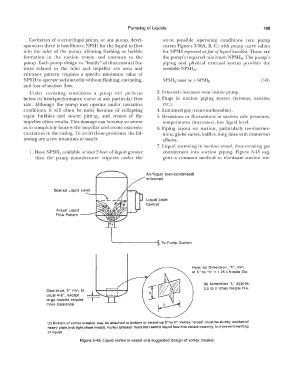
                                                                   7.  Liquid vortexing in suction vessel,  thus  creating gas
             1. Have NPSHA  available  at least 2 feet of  liquid greater   entrainment into  suction  piping.  Figure  3-43  sug-
                than  the  pump  manufacturer  requires  under  the   gests  a  common  method  to  eliminate  suction  var-


                                                               Air/Vapor (non-condensed)
                                                               entrained

                        Desired  Liquid  Level

                                                               Liquid  Level
                                                               Control
                         Actual  Liquid
                         Flow  Pattern  �-�•'t-__.���,--J


                                                ---------- To  Pump  Suction


                                                                                  Note:  (a)  Dimension,  "h",  min.
                                                                                  of  5" to "h" =  1.25 x Nozzle  Dia.

                                                                                       (b)  Dimension  "L"  approx.
                                                                                       3.5  to 5  times  Nozzle  Dia.
                     Clearance,  2"  min.  to
                     usual  4-6",  except
                     large  nozzies  require
                     more  clearance.


                     (c)  Bottom of vortex breaker may be attached to bottom or raised up 2" to 4". Vortex "cross" must be sturdy, welded of
                     heavy plate (not light  sheet metal). Vortex breaker must not restrict liquid flow into nozzle opening, but prevent swirling
                     of liquid.
                                   Figure 3-43.  Liquid vortex in vessel  and suggested design of vortex breaker.

