


Page 222 - APPLIED PROCESS DESIGN FOR CHEMICAL AND PETROCHEMICAL PLANTS, Volume 1, 3rd Edition
P. 222
192                       Applied Process Design for Chemical and  Petrochemical Plants

                Note  that  the  equivalent suction  lift  must be  added                      High altitude venting
             to  the  total  discharge  head  for  the  pump  system  to
             obtain  the  total  system  head.  Keep  in  mind  that  the
             work the pump must accomplish  is overcoming the suc-                P = 13.2 PSIA
             tion losses  ( +  or -  )  plus the discharge losses,  that is,  +       l            Low pressure water
             discharge  loss  (all)  - ( +  if head,  or  - if lift on suction
             losses,  all). Thus,  the  suction lift becomes a  (-) (-)  or           r
             a  ( +)  to  obtain  the  total  system  head.  Keep  in  mind
             that  a  vacuum  condition  on  the  suction  of  a  pump            P = 11.5 PSIA
                                                                                   200°FWater
             never helps  the  pump,  but in  effect is a  condition  that
                                                                          ..
             the pump must work  to overcome.                            0
                                                                          II
                                                                          (/)

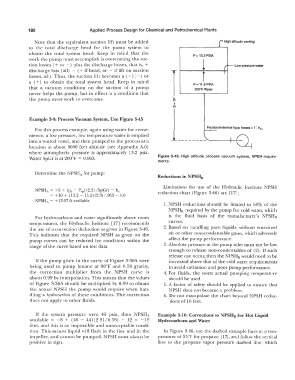
             Example 3-9: Process Vacuwn System, Use Figure 3-45
                                                                                       -
                                                                                        Friction/entrance type losses= 1', hsL
                For this process example, again using waler for conve-                                       .
             nience, a  low pressure, low  temperature water is emptied
             into a vented vessel,  and then pumped lo the process at a
             location  at about 3000  feet altitude  (see  Appendix  A-6)
             where  atmospheric  pressure  is  approximately  13.2  psia.
             Water SpGr is at 200°F  =  0.963.                     Figure 3-45.  High  altitude  process  vacuum  system,  NPSH  require-
                                                                   ments.

                Determine the NPSHA for pump:
                                                                   Reductions in NPSHR
                                                                      Limitations  for  use  of  the  Hydraulic  Institute  NPSH
                NPSHA  =  +S  +  (p.  --  P"P)(2.31/SpGr)  - h,1   reduction chart (Figure 3-46)  are  [17]:
                      =+IO+ (13.2  - 11.5)(2.3)/.963  - 1.0
                NPSHA  =  + 13.07 ft  available
                                                                      1. NPSH  reductions  should  be  limited  to  50%  of the
                                                                        NPSHR  required by  the pump for cold water,  which
                For hydrocarbons  and water significantly  above  room   is  the  fluid  basis  of  the  manufacturer's  NPSHR
              temperatures,  the  Hydraulic  Institute  [17]  recommends   curves.
              the use of a correction deduction as given  in Figure 3-'16.   2. Based  on  handling  pure  liquids,  without entrained
             This  indicates  that  the  required  NPSH  as  given  on  the   air or other non-condensable gases,  which adversely
             pump  curves  can  be  reduced  for  conditions  within  the   affect the pump performance.
             range of the curve based on test data.                   3. Absolute pressure at the pump inlet must not be low
                                                                        enough  to  release  non-condensables  of (2).  If such
                                                                        release can occur,  then the NPSHR would need to be
                If the  pump given  in  the curve of Figure  3-36A were   increased above that of the cold water requirements
              being  used  to  pump  butane  at  90°F  and  0.58  gravity,   to avoid cavitation and poor pump performance.
              the  correction  multiplier  from  the  NPSH  curve  is   4.  For  fluids,  the  worst  actual  pumping  temperature
              about 0.99 by interpolation.  This means that the values   should be used.
              of Figure  3-36A should be  multiplied by  0.99  to obtain   5. A  factor of safety  should  be  applied  to  ensure  that
              the  actual  NPSH  the  pump  would  require  when  han-   NPSH does not become a problem.
              dling a  hydrocarbon of these  conditions.  The correction   6.  Do  not extrapolate  the chart beyond NPSH  reduc-
              does  not apply  to  other fluids.                        tions of 10 feet.


                If  the  system  pressure  were  46  psia,  then  NPSHA   Example 3-10:  Corrections to NPSHR for Hot Liquid
              available  =  -8  +  (46  - 44) (2.31/0.58)  -  12  =  -12   Hydrocarbons and Water
             feet,  and  this is an  impossible and unacceptable  condi-
              tion. This means liquid will flash  in the line and in  the   In Figure  3-46,  use  the dashed example lines at a tem-
              impeller,  and cannot be pumped.  NPSH must always be   perature of 55°F for propane  [17), and follow the vertical
             positive  in  sign.                                   line  to  the  propane  vapor  pressure  dashed  line,  which

