


Page 230 - APPLIED PROCESS DESIGN FOR CHEMICAL AND PETROCHEMICAL PLANTS, Volume 1, 3rd Edition
P. 230
200                       Applied  Process Design for Chemical  and Petrochemical  Plants

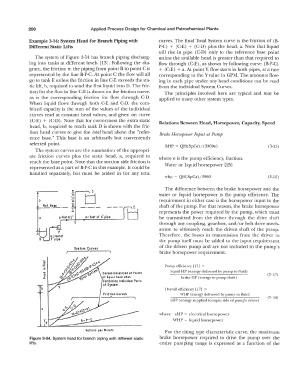
             Example 3-14:  System Head for Branch Piping with     curves.  The final Total  System curve  is  the friction of (B-
             Different Static Lifts                                P-C)  +  (C-E)  +  (C-D)  plus  the head,  a.  Note  that liquid
                                                                   will  rise  in  pipe  (C-D)  only  to  the  reference  base  point
                The system  of Figure 3-54 has  branch piping discharg-   unless  the available  head is greater than  that required  to
             ing  into  tanks  at different levels  [13]. Following  the  dia-   flow  through  (C-E), as  shown by following curve  (B-P-C)
             gram,  the friction in the piping from point B  to point C is   +  (C-E)  + a. At point Y,  flow starts in both pipes,  at a rate
             represented by  the line B-P-C. At point C  the flow will  all   corresponding to the Yvalue in GPM. The amounts flow-
             go to tank E unless the friction in line C-E exceeds the sta-   ing in each pipe under any head conditions can be  read
             tic lift, b, required to send the first liquid into D. The fric-   from the individual System Curves.
             tion for the flow in line C-E is shown on the friction curve,   The  principles  involved  here  are  typical  and  may  be
             as  is  the  corresponding  friction  for  flow  through  C'.,-D.   applied to many other system types.
             When  liquid  flows  through  both  C-E  and  C-D,  the  com-
             bined  capacity  is  the  sum  of the values  of the individual
             curves  read  at constant head values,  and given  on  curve
              (C-E)  +  (C-D). Note  that for correctness  the  extra static
             head,  b,  required  to  reach  tank D is shown with the fric-   Relations Between Head, Horsepower,  Capacity,  Speed
             tion  head  curves  to  give  the  total head  above  the  "refer-   Brake Horsepower Input at Pump
             ence  base."  This  base  is  an  arbitrarily  but  conveniently
             selected point.
                                                                      BHP= QH(SpGr)/(3960e)                      (3-15)
                The system curves are  the summation of the appropri-
             ate  friction  curves  plus  the  static  head,  a,  required  to   where e is the pump efficiency,  fraction.
             reach the base point.  Note that the suction side friction is
             represented as a part of B-P-C in this example.  It could be   \i\Tater or liquid horsepower  [25)
             handled  separately,  but must be  added  in  for  any  total
                                                                      whp  =  QH(SpGr)/3960                      (3-16)

                                                                      The difference between the brake horsepower and the
                                                                   water or liquid  horsepower is  the  pump  efficiency.  The
                                                                   requirement in either case is the horsepower input to the
                                                                   shaft of the pump.  For that reason,  the brake horsepower
                                                                   represents  the power required by  the  pump,  which  must
                          g·feet of l"   m·feet of n"pipe          be  transmitted  from  the  driver  through  the  drive  shaft
                                c                                  through any coupling,  gear-box,  and/or belt drive mech-
                                                                   anism  to  ultimately  reach  the  driven  shaft  of the  pump.
                                                                   Therefore,  the  losses  in  transmission  from  the  driver to
                                                                   the pump itself must be added to  the input requirement
                                                                   of the driven pump and  are  not included  in the  pump's
                                System  Curves
                                                                   brake horsepower requirement.

                                                                      Pump efficiency  [ 17)  =
                                                                        liquid HP  (energy delivered by pump to fluid)
                                            Curves Developed  ot Points                                         (3-17)
                                            of Equol head  when             brake HP  (energy to pump shaft)
                                            Combining  Individual Ports
                                            of System
                                                                      Overall efficiency  [ l 7]  =
                                                                            \VI-IP  ( energy delivered by pump to fluid)
                                                                                                                (3-18)
                                                                        el-IP (energy supplied to input side of pump's driver)
                  a
                                                                   where  eHP =  electrical horsepower
                                                                         WHP =  liquid horsepower
                                     Gallons  per Minute
                                                                      For the rising L)'Pe characteristic curve,  the maximum
             Figure 3-54. System head for branch  piping with  different static   brake  horsepower required  to  drive  the  pump  over  the
             lifts.                                                entire  pumping  range  is  expressed  as  a  function  of the

