


Page 232 - APPLIED PROCESS DESIGN FOR CHEMICAL AND PETROCHEMICAL PLANTS, Volume 1, 3rd Edition
P. 232
202 Applied Process Design for Chemical and Petrochemical Plants
�-tr�.,, 'J <,
(3-20) 60
�·
I
I\
>,
vs.
(3-21) �� �<:/. \2\ Efficiency 50 �
u
>---- ��� Cl ' ' Capacity >----- 40 �
/, ,�
:�
I '
(3-22) � I ' \ 30 �
20
Ill
For a fixed speed [25]:
100
�o
(3-23) 90 "'9.o.,,
80
(3-24) "'" \
70 � 11.5:
�·
� ,i> ' I Head
vs .
°:: 60 .o.,, ,-
(3-25) II. Capacity
c; K I \
; 50 '�2 \
"' ...
,__11.,-0
For geometrically similar impellers operating at the :i:: 40 -
same specific speed, the affinity laws are [25,11]: � \ \
30 I 7.5 j:
I I_\- f--1 ..
0
Q.
20 - 1'50 ?.\l"'" Broke - - �
5
0
(3- 26) � � :I:
450�
\,
10 ---- ""W'")-- 2.5 !:
-
Coprity
0 o - � O ID
120 160 200 240 280
40 80
(3- 27) Capacity, Gpm.
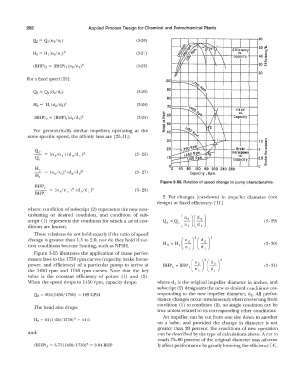
Figure 3-55. Relation of speed change to pump characteristics.
BHP 2
(3- 28)
BHP 1
2. For changes (cut-down) in impeller diameter (not
design) at fixed efficiency: [ 11]
where: condition of subscript (2) represents the new non-
cavitating or desired condition, and condition of sub-
script (I) represents the condition for which a set of con- (3- 29)
ditions are known.
These relations do not hold exactly if the ratio of speed
change is greater than 1.5 to 2.0, nor do they hold if suc-
tion conditions become limiting, such as NPSH. (3- 30)
Figure 3-55 illustrates the application of these perfor-
mance laws to the 1750 rpm curves (capacity, brake horse-
power, and efficiency) of a particular pump to arrive at (3- 31)
the 1450 rpm and 1150 rpm curves. Note that the key
value is the constant efficiency of points (1) and (2).
When the speed drops to 1450 rpm, capacity drops: where d, is the original impeller diameter in inches, and
subscript (2) designates the new or desired conditions cor-
Q 2 = 204(1450/1750) = 169 GPM responding to the new impeller diameter, d 2. All perfor-
mance changes occur simultaneously when converting from
condition (1) to condition (2), no single condition can be
The head also drops:
true unless related to its corresponding other conditions.
An impeller can be cut from one size down to another
H2 = 64(1450/1750) 2 = 44 ft
on a lathe, and provided the change in diameter is not
greater than 20 percent, the conditions of new operation
and: can be described by the type of calculations above. A cut to
reach 75-80 percent of the original diameter may adverse-
(BHP) 2 = 6.75(1450/1750) = 3.84 BJ-JP ly affect performance by greatly lowering the efficiency [ 4].
3

