


Page 237 - APPLIED PROCESS DESIGN FOR CHEMICAL AND PETROCHEMICAL PLANTS, Volume 1, 3rd Edition
P. 237
Pumping of Liquids                                       207

                                    ! 00   2 0 0  ...-...--..--.....---.---.---.----.---.----,.---,--,--,.--...--....-......-"T"-1
                                     90    180 �  .....  -==-+--+--+--+--+--+--+--+--+--+---+---+-+--+---l
                                     80


                            ...
                            Q.I
                            3
                            a 20
                            Q.I
                            s  15
                            :x:  IO
                            Q.I
                            ....:
                            �   5
                            CD
                                0
                                                   100   200  300  400  500
                                                      Capacity,  Gpm.
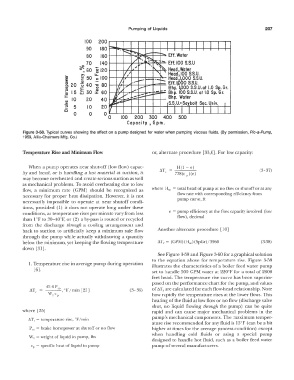
          Figure  3-58.  Typical  curves showing  the effect on  a  pump designed for water when  pumping  viscous fluids.  (By  permission,  Pie-a-Pump,
          1959,  Allis-Chalmers Mfg.  Co.)


          Temperature Rise and Minimum Flow                     or,  alternate procedure  [33,6]. For low  capacity:


             When a pump operates near shut-off (low flow)  capac-         1-1(1  - e)
           ity  and head,  or is  handling  a  hot material  at suction,  it   778(c  )(e)                   (3-37)
                                                                              P
           may become overheated and create serious suction as well
           as mechanical problems.  To avoid overheating due to low
           flow,  a  minimum  rate  (GPM)  should  be  recognized  as   where  H, 0  =  total head of pump at no flow or shutoff or at any
           necessary  for proper heat dissipation.  However,  it is  not   flow rate with  corresponding efficiency from
           necessarily  impossible  to  operate  at  near  shutoff condi-   pump curve, ft
           tions,  provided  (l)  it does  not operate  long under these
           conditions, as temperature rises per minute vary from less   e  =  pump efficiency at the flow capacity involved  (low
           than  I °F to 30-40°1·�  or (2)  a by-pass is routed or recycled   flow), decimal
          from  the  discharge  through  a  cooling  arrangement  and
           back  to  suction  to  artificially  keep  a  minimum  safe  Dow   Another alternate procedure  [10]
           through  the pump while actually withdrawing a  quantity
          below the minimum, yet keeping the flowing temperaLure   �Tr= (GPM) (H, 0)  (SpGr)/3960             (3-38)
          down  [31].
                                                                   See Figure 3-59 and Figure 3-60 for a graphical solution
                                                                to  the  equation  above  for  temperature  rise.  Figure  3-59
             1. Temperature rise in average pump during operation   illustrates  the characteristics of a  boiler feed water pump
               [6].
                                                                set to  handle 500  GPM water at 220°F for a  total  of 2600
                                                                feet head.  The temperature  rise curve has been superim-
                                                                posed on the performance chart for the pump, and values
                    42.4 P.
             �T     --- ' 0 -,°F/min  [25]             (3- 36)   of  �Tr are calculated for each flow-head relationship. Note
                r
                     W 1  cP                                    how rapidly the temperature rises at the lower flows.  This
                                                                heating of the fluid at low flow or no flow  ( discharge valve
                                                                shut,  no  liquid  flowing  through  the  pump)  can  be  quite
          where  [25]                                           rapid  and  can  cause  major mechanical  problems  in  the
             �Tr= temperature  rise,  °F/min                    pump's mechanical components.  The maximum temper-
                                                                ature rise recommended for any fluid is 15°F (can be a bit
             P, =  brake horsepower at shutoff or no flow       higher at times for the average process condition)  except
               0
                                                                when  handling  cold  fluids  or  using  a  special  pump
             W 1  =  weight of liquid in pump,  lbs
                                                                designed  to  handle hot fluid,  such  as  a boiler feed water
              cp  =  specific  heat of liquid in pump           pump of several manufacturers.

