


Page 369 - APPLIED PROCESS DESIGN FOR CHEMICAL AND PETROCHEMICAL PLANTS, Volume 1, 3rd Edition
P. 369
Mixing of Liquids                                       337


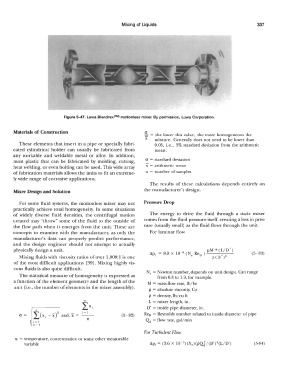
                           Figure 5-47. Luwa BlendrexCTM)  motionless mixer.  By permission,  Luwa Corporation.

       Materials of Construction
                                                             g.  =  the  lower this value,  the more  homogeneous  the
                                                             x   mixture.  Generally does  not need  to be  lower than
         These elements that insert in a  pipe or specially  fabri-   0. 05,  i.e.,  5% standard  deviation  from  the arithmetic
       cated  cylindrical  holder  can  usually  be  fabricated  from   mean.
       any  workable  and  weldable  metal  or  alloy.  In  addition,
       most  plastic  that can  be  fabricated  by  molding,  cutting,   cr  =  standard deviation
       heat welding, or even bolting can be used. This wide array   x = arithmetic mean
       of fabrication materials allows the units to fit an extreme-   n  =  number of samples
       ly wide range of corrosive applications.
                                                               The  results of these  calculations  depends  entirely  on
       Mixer Design and Solution                            the manufacturer's design.


         For some fluid systems,  the motionless  mixer may  not   Pressure Drop
       practically  achieve  total  homogeneity.  In  some situations
       of widely  diverse  fluid  densities,  the  centrifugal  motion   The  energy  to  drive  the  fluid  through  a  static  mixer
       created  may  "throw"  some  of the fluid  to  the outside  of   comes from the fluid pressure itself,  creating a loss in pres-
       the flow  path  when  it emerges  from  the unit.  These  are   sure  (usually small)  as the fluid flows  through  the unit.
       concepts  to  examine with  the  manufacturer,  as  only  the   For laminar flow
       manufacturer's  data  can  properly  predict  performance,
       and  the  design  engineer should  not  attempt to  actually
       physically design a unit.                               �p 1  =  8.9  X  10-s  (N  Re  )   µM  *(L/D')   (5- 83)
         Mixing fluids with viscosity ratios of over 1,000: 1  is one           e   D   p (  D,  )3
       of the most difficult applications  [39]. Mixing highly vis-
       cous fluids is also quite difficult.
                                                             Ne  =  Newton number,  depends on unit design.  Can  range
         The statistical  measure of homogeneity is expressed as   from 0.8 to  1.9, for example.
       a function of the element geometry and the length of the   M  =  mass flow rate,  lb/hr
       unit (i.e., the number of elements in the mixer assembly).
                                                              µ  = absolute viscosity,  Cp
                                                              p  =  density,  lb/  cu ft
                                   v.                         D' =  inside pipe diameter,  in.
                                                              L  =  mixer length,  in.
                                    n
         o  =   �� (  xi  - x   -   �   I          (5- 82)   Re 0  =  Reynolds  number related to  inside diameter of pipe
                       -)2  and,  x  =
               :':"':              --n-                      Q 8  =  flow rate,  gal/min
               " - I
                                                            For Turbulent Fl.ow
       xi  =  temperature, concentration or some other measurable
           variable                                                                                       (5-84)

