


Page 366 - APPLIED PROCESS DESIGN FOR CHEMICAL AND PETROCHEMICAL PLANTS, Volume 1, 3rd Edition
P. 366
334                       Applied Process Design for Chemical and Petrochemical  Plants

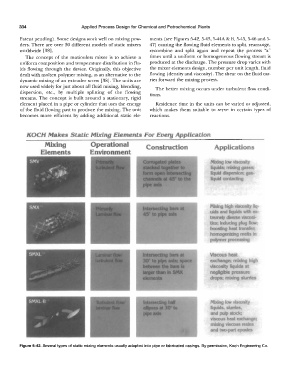
         Patent pending). Some designs work well on mixing pow-   men ts  (see Figures 5-42, 5-43, 5-44A & B, 5-45, 5-46 and 5-
         ders.  There  are over 30 different models of static  mixers   47)  causing the flowing fluid elements to split,  rearrange,
         worldwide  [38].                                      recombine  and  split  again  and  repeat  the  process  "x"
            The  concept  of the  motionless  mixer  is  to  achieve  a   times until  a  uniform or homogeneous flowing stream  is
         uniform composition and temperature distribution in flu-   produced at the discharge. The pressure drop varies with
         ids  flowing  through  the  device.  Originally,  this  objective   the mixer elements design, number per unit length, fluid
         dealt with molten polymer mixing,  as an alternative to the   flowing ( density and viscosity). The shear on the fluid car-
         dynamic mixing of an extruder screw  [38]. The units are   ries forward the mixing process.
         now used widely for just about all fluid mixing,  blending,   The better mixing occurs under turbulent flow condi-
         dispersion,  etc.,  by  multiple  splitting  of  the  flowing   tions.
         streams.  The  concept is  built around  a  stationary,  rigid
         element placed in a  pipe or cylinder that uses  the energy   Residence time in the units can be varied or adjusted,
         of the fluid flowing past to produce the mixing.  The unit   which  makes  them  suitable  to  serve  in  certain  types  of
         becomes  more  efficient  by  adding  additional  static  ele-   reactions.


            KOCH M          s Static Mixing Elements For Every Application

                                                                           on


         Figure 5-42.  Several types of static mixing elements usually adapted into pipe or fabricated casings.  By permission,  Koch  Engineering Co.

