


Page 376 - APPLIED PROCESS DESIGN FOR CHEMICAL AND PETROCHEMICAL PLANTS, Volume 1, 3rd Edition
P. 376
344                       Applied Process Design for Chemical  and Petrochemical  Plants

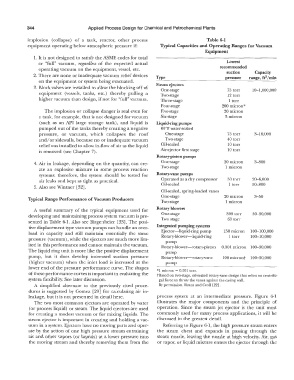
             implosion  (collapse)  of  a  tank,  reactor,  other  process             Table 6-1
             equipment operating below atmospheric pressure if:     Typical Capacities and Operating Ranges for Vacuum
                                                                                       Equipment
               1. It is not designed to satisfy  the ASME codes for total
                 or  "full"  vacuum,  regardless  of the  expected  actual                      Lowest
                 operating vacuum on the equipment,  vessel, etc.                            recommended
                                                                                                suction
                                                                                                            Capacity
               2. There are none or inadequate vacuum relief devices   Type                    pressure   range, ft3 /min
                 on the equipment or system being evacuated.
               3. Block valves are installed to allow the blocking off of   Steam ejectors      75 torr   10-1,000,000
                 equipment  (vessels,  tanks,  etc.)  thereby  pulling  a   One-stage           12 torr
                                                                    Two-stage
                 higher vacuum than design, if  not for "full" vacuum.   Three-stage             L  torr
                                                                    Four-stage                200 micron*
                    The implosion or collapse danger is real even for   Five-stage             20 micron
                 a tank, for example,  that is not designed for vacuum   Six-stage             3 micron
                  (such  as  an  API  large  storage  tank),  and  liquid  is   Liquid-ring pumps
                 pumped out of the tanks thereby creating a negative   60°F water-sealed
                 pressure,  or  vacuum,  which  collapses  the  roof   One-stage                75 torr    3-10,000
                 and/or sidewalls, because no or inadequate vacuum    Two-stage                 40  torr
                 relief  was installed to allow in-flow of air as the liquid   Oil-sealed       10 torr
                 is removed  (see Chapter 7).                       Air-ejector first stage     lO  torr
                                                                  Rotary-piston pumps
               4. Air in  leakage,  depending on  the  quantity,  can  cre-   One-stage        20 micron   3-800
                 ate  an  explosive  mixture  in  some  process  reaction   Two-stage          1  micron
                 systems;  therefore,  the  system  should  be  tested  for   Rotary-vane pumps
                 air leaks and kept as  tight as practical.         Operated as a dry compressor   50 torr   20-6,000
               5. Also see Wintner l32].                            Oil-sealed                   1  torr   50-800
                                                                    Oil-sealed, spring-loaded vanes
                                                                    One-stage                  20 micron   3-50
             Typical Range Performance of Vacuum Producers
                                                                    Two-stage                  I  micron
               A  useful  summary  of the  typical  equipment used  for   Rotary blowers
             developing and maintaining process system vacuum is pre-   One-stage               300 torr   30-30,000
             sented in Table 6-1. Also  see Birgenheier  [33). The posi-   Two stage            60  torr
             tive displacement type vacuum pumps can handle an over-   Integrated pumping systems
             load  in  capacity  and  still  maintain  essentially  the  same   Ejector-liquid-ring pump   150 micron   100-100,000
             pressure  (vacuum), while the ejectors are much more lim-   Rotary-blower-liquid-ring   1  torr   100-10,000
                                                                      pump
             ited in this performance and cannot maintain the vacuum.   Rotary-blower-rotary-piston   0.001  micron  100-30,000
             The liquid ring unit is more like the positive displacement   pump
             pump,  but  it  does  develop  increased  suction  pressure   Rotary-blower-rotary-vane   100 micron+  100-30,000
             (higher vacuum)  when  the inlet load  is  increased  at the   pump
             lower end of the pressure performance curve. The shapes   *l micron  = 0.001  torr.
             of these performance curves is important  in evaluating the   +Based on two-stage, oil-sealed rotary-vane design that relies on centrifu-
             system flexibility.  See later discussion.            gal force  Lo throw the vanes against the casing wall.
               A  simplified  alternate  t.o  the  previously  cited  proce-   By permission, Ryans and Croll  [22].
             dures  is  suggested  by  Gomez  [29)  for calculating  air in-
             leakage,  but it is not presented in detail here.     process  system  at  an  intermediate  pressure.  Figure  6-1
               The  two  most common ejectors are operated by water   illustrates  the  major  components  and  the  principle  of
             (or process liquid)  or steam.  The liquid ejectors are used   operation.  Since  the  steam jet  ejector  is  the  unit  most
             for creating a  modest vacuum or for mixing liquids.  The   commonly  used for many  process  applications,  it will  be
             steam ejector is important in creating and holding a vac-   discussed in the greatest detail.
             uum in a system. Ejectors have no moving parts and oper-   Referring to Figure 6-1, the high pressure steam enters
             ate  by  the action of one high pressure  stream entraining   the  steam  chest  and  expands  in  passing  through  the
             air and other vapors  (or liquids)  at a  lower pressure into   steam  nozzle,  leaving the  nozzle  at high velocity.  Air,  gas
             the moving stream and thereby removing them from  the   or vapor,  or liquid mixture enters  the ejector through the

