


Page 379 - APPLIED PROCESS DESIGN FOR CHEMICAL AND PETROCHEMICAL PLANTS, Volume 1, 3rd Edition
P. 379
Ejectors and  Mechanical Vacuum Systems                           347

                                                                            PIIESSURE                  AIR  INLET
                                         HGUlATIHG                             +                          j
                                         SPINDLE
                                                                     z
                                                                     0
                                                                     6 ..
                                                                     :::,
                                                                     "'


                                                                                                         I
                  D!SCHAIGf                  DISCHARGE                      DISCHARGE                 DISCHARGE
               STEAM  JET               JET  COMPRESSOR                   JET  SYPHON          STEAM  JET  BLOWER
              VACUUM  PUMP                                                                     AND  BLAST  NOZZLE


                SUPERHEATED
                STEAM  INLET
                    I                                                        PIESSURI
                                                                             WATfR


                                                                             DISCHARGE
                DESUPERHEATED
                STEAM  OUTLET
             DESUPERHEAT ER          LIQU!D  MIXING  EDUCTOR           FUME  SCRUBBER

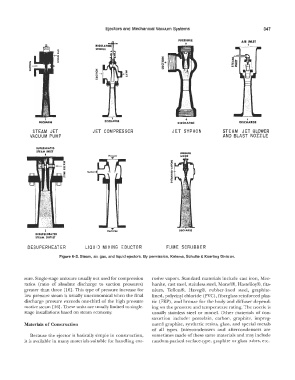
                          Figure 6-2.  Steam, air,  gas,  and liquid ejectors.  By permission,  Ketema,  Schutte & Koerting Division.


           sure. Single-stage  units are usually not used for compression   rosive  vapors.  Standard  materials  include  cast iron,  Mee-
           ratios  (ratio  of absolute  discharge  to  suction  pressures)   haniie, cast steel, stainless steel, Mone!®, Hastelloy®,  tita-
           greater than  three  [16]. This  type  of pressure  increase  for   nium,  Teflon®,  Haveg®,  rubber-lined  steel,  graphite-
           low  pressure  steam  is  usually uneconomical when the final   lined,  polyvinyl  chloride (PVC), fiberglass reinforced plas-
           discharge  pressure  exceeds  one-third of the  high  pressure   tic  (FRP), and  bronze for the body and diffuser depend-
           motive steam [ 16]. These units are usually limited to single-   ing on the pressure and temperature rating. The nozzle is
           stage installations based on steam economy.           usually  stainless  steel  or monel.  Other materials  of con-
                                                                 struction  include:  porcelain,  carbon,  graphite,  impreg-
           Materials of Construction                             nated graphite,  synthetic  resins,  glass,  and  special  metals
                                                                 of  all  types.  lntercondensers  and  aftercondensers  are
              Because the ejector is basically simple in construction,   sometimes made of these same materials and may include
           it is available in many materials suitable for handling cor-   random-packed surface-type,  graphite or glass  tubes, etc.

