


Page 398 - APPLIED PROCESS DESIGN FOR CHEMICAL AND PETROCHEMICAL PLANTS, Volume 1, 3rd Edition
P. 398
366                       Applied Process Design for Chemical and Petrochemical  Plants
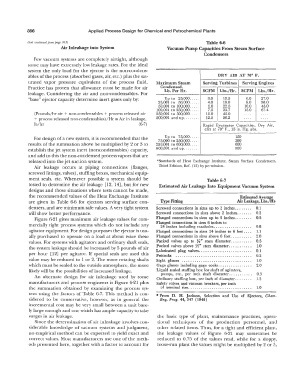
             (text r.;mlinued [rom page 363)                                           Table 6-6
                          Air Inleakage into System                    Vacuum Pump Capacities From Steam Surface
                                                                                      Condensers
               Few vacuum  systems  are  completely airtight,  although
             some may have extremely low leakage  rates.  For the ideal
             system  the  only  load  for  the  ejector is  the  non-condens-
             ables of the process  (absorbed gases, air,  etc.)  plus the sat-              DRY  AIR  AT  70°  F.
             urated  vapor  pressure  equivalent  of  the  process  fluid.   Maximum Steam   Serving Turbines   Serving Engines
             Practice has  proven  that allowance  must be made for air   Condensed,
             leakage.  Considering  the  air and  non-condensables.  For   Lb. Per Hr.   SCFM   Lbs./Hr.   SCFM   Lbs./Hr.
             "base" ejector capacity determine inert gases only by:   Up to  25,000 .....   3.0   13.5   6.0   27.0
                                                                   25,001  to  50,000 .....   4.0   18.0   8.0   36.0
                                                                   50,001  to  100,000 .....   5.0   22.5   10.0   45.0
                                                                   100,001  to 250,000 .....   7.5   33.7   15.0   67.4
               (Pounds/hr air + non-condensables + process released air   250,001  to 500,000 .....   10.0   45.0   .  .  .  .   ....
                                                                                              56.2
                                                                                       12.5
               +  process released non-condensables)/Hr = Air in leakage,   500,001  and up ........  ---------   .  .  .  .   ....
               lb/hr                                       (6-7)                      Rapid  Evacuator  Capacities,  Dry  Air.
                                                                                       cfm  at 70°  F.,  15 in. I-lg.  abs.
                                                                                     -------------------
                                                                      Up  to  75,000 .....
                                                                                                    150
               For design of  a new system,  it is recommended that the   7 5,000  to 250,000 .....   300
             results of the summation above be multiplied by 2 or 3  to   250,001  to 600,000 .....   600
             establish the jet system inert (noncondensables)  capacity,   600,001  and up ........   900
             and add to this the non-condensed process vapors that are
             released into  the jet suction system.                *Standards  of  Heat  Exchange  Institute,  Steam  Surface  Condensers,
               Air  leakage  occurs  at  piping  connections  (flanges,   Third Edition, Ref.  (12)  by permission.
             screwed fittings, valves), stuffing boxes, mechanical equip-
             ment  seals,  etc.  Whenever  possible  a  system  should  be             Table 6-7
             tested to determine the air leakage  [ 12,  14], but for new   Estimated Air Leakage Into Equipment Vacuum System
             designs and those situations where tests cannot be made,
             the recommended values of the Heat Exchange  Institute                                  Estimated Average
             are  given  in  Table  6-6  for  ejectors  serving  surface  con-   Type Fitting       Air Leakage, Lbs./Hr.
             densers, and are minimum safe values. A very tight system   Screwed  connections  in  sizes  up  to  2  inches. .  .  .  .  .  .  .   0.1
             will show heller performance.                        Screwed  connections  in  sizes  above  2  inches.......  0.2
               Figure 6-21  gives maximum air leakage values for com-   Flanged  connections  in  sizes  up  to  6  inches. .  .  .  .  .  .  .   0.5
             mercially  tight process  systems which  do  not include  any   Flanged  connections  in sizes  6  inches  to   0.8
                                                                    24 inches  including manholes. .  .  .  .  .  .  .  .  .  .  .  .  .  .  .  .  .
             agitator equipment.  For design purposes the ejector is usu-   Flanged  connections  in  sizes  24  inches  to  6  feet. .  .  .   1.1
             ally  purchased  to  operate  on  a  load at about twice  these   Flanged  connections  in  sizes  above  6  feet. .  .  .  .  .  .  .  .  .   2.0
             values.  For systems with agitators  and ordinary shaft seals,   Packed  valves  up  to  !/!"  stem  diameter. .  .  .  .  .  .  .  .  .   0.5
             the system leakage should be increased by 5  pounds  of air   Packed  valves  above  !/!" stem  diameter. .  .  .  .  .  .  .  .  .  .   1.0
             per  hour  [12]  per agitator.  If special  seals  are  used  this   Lubricated  plug  valves.........................  0.1
                                                                                                            0.2
                                                                  Petcocks  .  .  .  .  .  .  .  .  .  .  .  .  .  .  .  .  .  .  .  .  .  .  .  .  .  .  .  .  .  .  .  .  .  .  .  .
             value  may be reduced to  1  or 2. The more  rotating shafts   Sight  glasses  .  .  .  .  .  .  .  .  .  .  .  .  .  .  .  .  .  .  .  .  .  .  .  .  .  .  .  .  .  .  .  .  .   1.0
             which must be sealed to the outside atmosphere, the more   Gage  glasses  including  gage  cocks. .  .  .  .  .  .  .  .  .  .  .  .  .  .  .   2.0
             likely will be the possibilities of increased leakage.   Liquid  sealed stuffing box for shaft of agitators,
                                                                    pumps,  etc.,  per  inch  shaft  diameter...........  0.3
               An  alternate  design  for  air  inleakage  used  by  some   Ordinary  stuffing box,  per inch  of  diameter. .  .  .  .  .  .  .   1.5
             manufacturers and process  engineers  is  Figure  6-21  plus   Safety valves  and vacuum breakers, per inch
             the  summation  obtained  by  examining  the  process  sys-   of  nominal  size. .  .  .  .  .  .  .  .  .  .  .  .  .  .  .  .  .  .  .  .  .  .  .  .  .  .  .  .  .   1.0
             tem  using  the factors  of Table  6-7.  This  method  is  con-   * From  D.  H.  Jackson,  Selection  and  Use  of  Ejectors,  Chem.
             sidered  to  be  conservative,  however,  as  in  general  the   Eng.  Prog,  44,  347  (1948)
             incremental cost may  be very small  between a unit bare-
             ly large enough and one which has ample capacity to take
             surges in air leakage.                                the  basic  type  of plant,  maintenance  practices,  opera-
                Since the determination of air inleakage involves con-   tional  techniques  of  the  production  personnel,  and
             siderable  knowledge  of vacuum  systems  and judgment,   other related items.  Thus, for a  tight and efficient plant,
             no empirical method can be expected to yield exact and   the  leakage  values  of  Figure  6-21  may  sometimes  be
             correct values.  Most manufacturers  use one of the meth-   reduced  to  0.75  of the  values  read,  while  for  a  sloppy,
             ods presented here,  together with a factor to account for   loose-run plant the values might be multiplied by 2 or 3,

