


Page 394 - APPLIED PROCESS DESIGN FOR CHEMICAL AND PETROCHEMICAL PLANTS, Volume 1, 3rd Edition
P. 394
362                      Applied Process Design for Chemical and Petrochemical  Plants

            Example 6-4: Steam Air Mixture Temperature in Ejector   3. The  70°F air equivalent correcting for temperature
                                                                      is found as previously described,  using the air curve
               Steam used to draw air out of a vessel is:             of Figure  6-17.
                 240 psig  (255 psia)  @  440°F total  temp
                 This is:  440  - 402 sat temp  =  38  superheat   Example 6-5: Actual Capacity For Process Vapor Plus
               Temp of air from vessel:  75°F                     N on-Condensable
               Steam flow:  475 lbs/hr
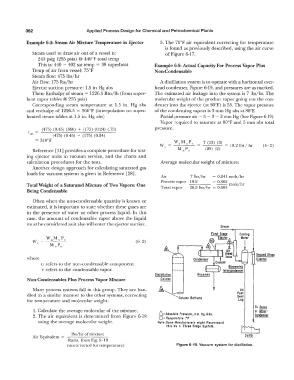
              Air flow:  175 lbs/hr                                 A distillation system is to operate with a horizontal over-
               Ejector suction pressure:  1.5 in Hg abs           head condenser,  Figure 6-19, and pressures are as marked.
               Then:  Enthalpy of steam =  1226.5 Btu/lb (from super-   The  estimated air leakage  into  the system is 7 lbs/hr.  The
            heat vapor tables  @  255 psia)                       molecular weight of the  product vapor going out the con-
               Corresponding  steam  temperature  at  1.5  in.  Hg  abs   denser into the ejector (at S0°F)  is 53.  The vapor pressure
            and enthalpy of 1226.5  =  366°F (interpolation on super-   of the condensing vapors  is 3 mm Hg abs at 80°F.
            heated steam tables at 1.5 in.  Hg abs)                 Partial pressure air= 5 - 3 = 2 mm Hg (See Figure 6-19)
                                                                    Vapor required  to saturate at 80°F and 5  mm abs  total

             t  =   (475)  (0.45)  (366)  +  (175)  (0.24)  (.75)   pressure.
              rn       ( 475)  (0.45)  +  (175)  (0.24)
                =  318° F
                                                                                            3
                                                                    w                 7  53 )  ( )  =  19. 2  lbs I  hr   (6- 2)
                                                                                        (
               Reference  [11]  provides a complete procedure for test-   \'           (29)  (2)
            ing  ejector units  in vacuum  service,  and  the  charts  and
            calculation procedures for the tests.                   Average molecular weight of mixture:
               Another design  approach for calculating saturated gas
            loads for vacuum systems is given in Reference  [28].
                                                                    Air          7 lbs/hr   =  0.241  mols/hr
                                                                    Process vapor  19.2   =  0.362
                                                                                            --mos
            Total Weight of a Saturated Mixture of Two Vapors:  One   Total vapor   26.2 lbs/hr  =  0.603   1  /h  r
            Being Condensable
               Often when the non-condensable quantity is known or
            estimated,  it is important to state whether these gases are
            in  the  presence  of water or other process  liquid.  In  this
            case,  the  amount of condensable vapor above  the liquid
            must be considered as it also will enter the ejector suction.
                                                                                             Steam

                                                          (6-2)


                                                                                                            Second  Stag�
            where                                                                                            �.!.£!2!
                  n refers  to the non-condensable component
                   v refers  to the condensable vapor.
                                                                  Distillation
            Non-Condensables Plus Process Vapor Mixture             Column

               Many process systems fall in  this group.  They are han-                               34
                                                                                                     Feet
            dled in a similar manner to  the other systems,  correcting   �Column  Bottoms          Seal
            for temperature and molecular weight.                                                    Leo
                                                                                                            To  Sume.
               l. Calculate the average molecular of the mixture.                                           or  After-
               2. The  air equivalent is  determined from  Figure  6-18   6=  Absolute  Pressure, mm. Hg. Abs.   Condenser
                                                                    O= Temperature  , °F
                 using the average molecular weight.               Note :Some  Manufacturers  might  Recommend
                                                                       this  as  a  Three  Stage  Sy&tem.
                               lbs/hr of mixture
               Air Equivalenl =
                              Ratio,  from Fig. 6- 18
                             (uncorrected for temperature)                 Figure 6-19. Vacuum system for distillation.

