


Page 504 - APPLIED PROCESS DESIGN FOR CHEMICAL AND PETROCHEMICAL PLANTS, Volume 1, 3rd Edition
P. 504
470                       Applied Process Design for Chemical and Petrochemical  Plants

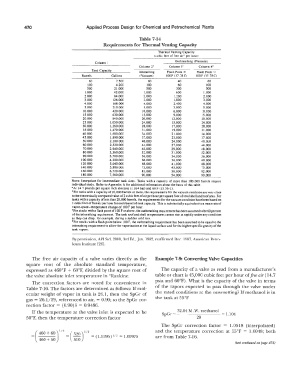
                                                           Table 7-14
                                            Requirements for Thermal Venting Capacity
                                                                   Thermal  venung Capacity
                                                                 (cubic  feet of free air"  per hour)
                                                                          Outbreathing (Pressure)
                                         Column  I
                                                           Column zh   Column  3'   Column 4•
                                       Tank Capacity       lnbreathing   Flash Point;,.   Flash Point  <
                                   Barrels     Gallons     (Vacuum)   IOOF (37  78C)   IOOF (37.78C)
                                      60         2.500         60          40          60
                                      100        4.200        100          60          100
                                     500         21.000       500         300          500
                                    1.000       42,000       1,000        600         1.000
                                    2.000        84,000      2.000       1.200        2.000
                                    3.000       126.000      3.000       1,800        3.000
                                    4.000       168.000      4.000       2.400        4.000
                                    5.000       210.000      5.000       3.000        5.000
                                    10.000      420,000     10.000       6.000       10.000
                                    15.000      630.000     15.000       9.000       15.000
                                    20.000      840,000     20,000       12,000      20.000
                                    25,000     1.050.000    24,000       15.000      24.000
                                    30,000     1,260,000    28,000       17.000      28.000
                                    35.000     1.470,000    31.000       19.000      31.000
                                   40,000      1,680,000    34.000      21.000       34.000
                                   45.000      1,890,000    37 ,000      23,000      37 .000
                                    50,000     2,100.000    40.000      24.000       40.0\JO
                                    60,000     2,520,000    44,000      27 ,000      44.000
                                    70,000     2.940.000    48,000      29,000       48,000
                                    80,000     3,360,000    52.000      31.000       52.000
                                    90,000     3,  780,000   56,000     34.000       56,000
                                   100,000     4,200.000    60.000      36.000       60.000
                                   120,000     5.040.000    68.000      41.000       68.000
                                   140,000     5.880,000    75,000      45.000       75.000
                                   160,000     6,720.000    82,000      50,000       82.000
                                   180,000     7,560,000    90.000      54.000       90.000
                               NoTE:  Interpolate  for  intermediate tank  sizes.  Tanks  with  a  capacity  of more  than  180.000 barrels  require
                               individual  study.  Refer to Appendix  A  for additional  information about the basis of this table.
                               • At  14. 7  pounds per square inch absolute (1.014 bar) and 60 F  (15.56 C).
                               "For tanks with a capacity of 20.000 barrels or more. the requirements for the vacuum condition are very close
                               to the theoretically computed value of 2 cubic feet of air per hour per square foot of total shell and roof area. For
                               tanks with a capacity of less than 20.000 barrels. the requirements for the vacuum condition have been based on
                               I  cubic foot of free air per hour for each barrel of lank capacity. This is substantially equivalent to a mean rate of
                               vapor-space-temperature change of I 00 F per hour.
                               'For stocks with a flash point of 100 For above. the outbreathing requirement has been assumed 10 be 60 percent
                               of the inbreathing requirement.  The tank roof and shell temperatures cannot rise as rapidly under any condition
                               as they can drop. for example, during a sudden cold rain.
                               •For stocks with a flash point below  100 F, the outbreathing requirement has been assumed 10 be equal to the
                               inbrearhing requirement to allow for vaporization al the liquid surface and for the higher specific gravity of the
                               tank  vapors.
                               By permission, API  Std.  2000,  3rd Ed.,Jan.  1982, reaffirmed Dec.  1987, American  Petro-
                               leum  Institute  (26].

              The  free  air  capacity  of a  valve  varies  directly  as  the   Example 7-9:  Converting Valve  Capacities
            square  root  of  the  absolute  standard  temperature,
            expressed as 460°F +  60°F,  divided by  the square root of   The  capacity of a valve  as  read from  a  manufacturer's
            the valve absolute inlet temperature in  °Rankine.    table or chart is 45,000 cubic feet per hour of.free air ( 14. 7
                                                                  psia and 60°F). What is the capacity  of the valve in terms
              The  correction  factors  are  noted  for  convenience  in
            Table 7-16.  The factors are determined as follows:  If mol-   of the vapors  expected  to  pass  through  the valve  under
            ecular weight of vapor in  tank is  26.1, then  the  SpGr  of   the rated conditions at the same setting?  If methanol is in
            gas  =  26.1/29, referenced to air,  = 0.90;  so the SpGr cor-   the tank at 55°F
            rection factor =  (0.90)�  =  0.9486.
                                                                           32.04 M .W. methanol
              If the  temperature  at the valve  inlet is  expected  to  be   SpGr = --------  = 1.104
            50°F,  then the temperature correction factor                          29
                                                                    The  SpGr  correction  factor  =  1.0518  (interpolated)
                (460+60) 112   ( �    )112                        and  the  temperature  correction  at 55°F  =  1.0018;  both
              =              =   020   = ( 1.0196) 1 = 1.00975    are from Table 7-16.
                                                1 2
                 460 + 50       510
                                                                                                   (text continued on page 471)

