


Page 75 - APPLIED PROCESS DESIGN FOR CHEMICAL AND PETROCHEMICAL PLANTS, Volume 1, 3rd Edition
P. 75
Fluid Flow                                            59

           Usual Industry Pipe Sizes and Classes Practice        the  corrosion  rate  over a  five-year life  required  0.125
                                                                 in.  (Ys  in.), then  the 0.200  in.  +  0.125  in.  =  0.325  in.
              Certain  nominal  process  and  utility  pipe  sizes  are   and the Schedule 40 pipe would not be strong enough
            not in common  use  and hence  their availability  is  lim-   at the end  of five  years.  Often  the corrosion  is  calcu-
            ited. Those not usually used are:  %  in., lX in., 2�  in., 3X   lated for 10- or 15-years' life  before replacement.  Cur-
            in., 5  in., 22 in., 26 in.,  32  in., 34 in.        rently  Schedule  80,  3-in.  pipe  has  a  0.300  in.  wall
              Some of the larger sizes, 22 in. and up, are used for spe-   thickness,  so  even  this  is  not good  enough in  carbon
           cial  situations.  Also,  some  of  the  non-standard  process   steel. Rather than use the much heavier Schedule 160,
           sizes such as 2x; in., 3% in. and 5 in. are used by "packaged"   the  designer should  reconsider  the  materials  of con-
           equipment suppliers  to connect components in their sys-   struction  as  well  as  re-examine  the  corrosion  data  to
            tem  for use in processes  such as  refrigeration,  drying,  or   be  certain  there  is  not  unreasonable  conservatism.
           contacting.                                           Perhaps  stainless  steel  pipe  or  a  "lined"  pipe  would
              The most common schedule in use is 40,  and it is use-   give adequate strength and corrosion resistance.  For a
           ful  for a wide  range  of pressures  defined  by ANSI  Std.  B   bad  corrosion  condition,  lined  pipe  using  linings  of
            36. l  (American  National  Standards).  Lighter wall  thick-   PVC  (polyvinyl  chloride), Teflon®,  or Saran®  typically
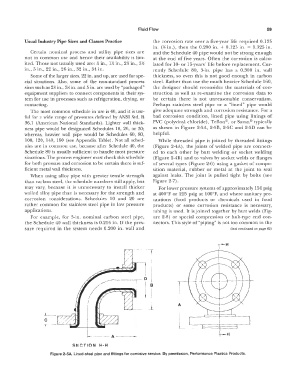
            ness  pipe  would be  designated  Schedules  10,  20,  or  30;   as  shown  in  Figure  2-5A,  2-5B,  2-5C  and  2-50 can  be
           whereas,  heavier  wall  pipe  would  be  Schedules  60,  80,   helpful.
            100,  120,  140,  160  (see  Appendix  Table). Not all  sched-   While  threaded  pipe  is joined  by  threaded  fittings
           ules  are  in  common use,  because  after Schedule  40,  the   (Figure  2-4A), the joints  of welded  pipe  are  connect-
            Schedule  80 is  usually  sufficient to handle most pressure   ed  to  each  other  by  butt  welding  or  socket  welding
           situations. The process engineer must check this schedule   (Figure  2-4B)  and to valves  by socket welds  or flanges
           for both pressure and corrosion to be certain there is suf-   of several  types  (Figure  2-6)  using a  gasket of compo-
            ficient metal wall thickness.                        sition  material,  rubber  or  metal  at  the joint  to  seal
              'When  using alloy  pipe  with  greater  tensile  strength   against  leaks.  The joint  is  pulled  tight by  bolts  (see
            than carbon steel, the schedule numbers still apply,  but   Figure  2-7).
            may  vary,  because  it  is  unnecessary  to  install  thicker   For lower pressure systems of approximately 150 psig
           walled alloy pipe than  is necessary for the strength and   at 400°F  or  225  psig  at  l00°F,  and where  sanitary  pre-
           corrosion  considerations.  Schedules  10  and  20  are   cautions  (food  products  or  chemicals  used  in  food
           rather common  for stainless  steel  pipe  in low  pressure   products)  or  some  corrosion  resistance  is  necessary,
           applications.                                         tubing is  used.  It is joined  together by  butt welds  (Fig-
              For  example,  for  3-in.  nominal  carbon  steel  pipe,   ure  2-8)  or  special  compression  or hub-type  end  con-
            the Schedule 40 wall thickness  is 0.216 in.  If the pres-   nectors. This style of "piping" is not too common in the
            sure  required  in  the  system  needs  0.200  in.  wall  and                         (text continued on page 62)


                                                                                                H


                                                                B           1
                                                                 I
                                                                 I
                                                                            I
                                                                            A
                    L-��--,--,                                              I
                    c                                                       L
                    T  -


                                SECTION  H-H
                      Figure 2-5A.  Lined-steel  pipe and fittings for corrosive service.  By permission,  Performance Plastics Products.

