


Page 78 - APPLIED PROCESS DESIGN FOR CHEMICAL AND PETROCHEMICAL PLANTS, Volume 1, 3rd Edition
P. 78
62                       Applied Process Design for Chemical and Petrochemical  Plants


                                            Orifice  flanges are widely used  in conjunction  with orifice meters for measuring the rate of
                                            flow of liquids and gases.  They are basically the same as standard welding neck,  slip-on and
                                            screwed flanges except for the provision  of radial,  tapped  holes  in the flange  ring for meter
                                            connections and additional  bolts to act as jack screws to facilitate separating the flanges for
                                            inspection or replacement of the orifice plate.


                                            Blind flanges are used to blank off the ends of piping, valves and pressure vessel  openings.
                                            From the standpoint of internal pressure and bolt loading, blind flanges, particularly in the larg-
                                            er sizes,  are the most highly stressed of all American  Standard flange types;  however,  since
                                            the maximum stresses in a blind flange are bending stresses at the center,  they can safely be
                                            permitted to be higher than  in other types of flanges.
         1.) In Tube Tums tests of all types of flanged assemblies, fatigue failure invariably occurred In the pipe or in an  unusually weak weld, never in the flange proper.
           The type of flange,  however, and particularly the method of attachment, greatly influence the number of cycles required to cause fracture.
         2.) ANSI  816.5-1961-Steel  Pipe Flanges and Flanged Fittings.
         3.) ASME Boller and Pressure Vessel Code 1966, Section I,  Par.  P-300.

         Figure 2-6.  Continued.  Forged steel companion flanges to attach to steel  pipe by the methods indicated.  By permission, Tube Turn Tech-
         nologies,  Inc.


          Male to  Male   Male te Female
          Flanged  Joint   Flanged  Joint
                                                        A11ambled Ring Joint
                         Tongue & Grove Joint                                                      Gaskets
                          (uaee flat gasket)
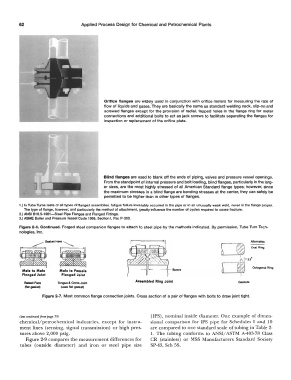
                  Figure 2-7.  Most common flange connection joints.  Cross section of a pair of flanges with  bolts to draw joint tight.


         (uxt continued  from page 59)                         (IPS), nominal  inside diameter.  One example of dimen-
         chemical/petrochemical  industries,  except  for  instru-   sional  comparison  for IPS  pipe  for Schedules  5  and  10
         ment lines  (sensing,  signal  transmission)  or high  pres-   are compared to one standard scale of tubing in Table 2-
         sures above 2,000  psig.                              1.  The  tubing  conforms  to  ANSI/  ASTM  A-403-78  Class
            Figure 2-9  compares  the measurement differences for   CR  (stainless)  or  MSS  Manufacturers  Standard  Society
         tubes  (outside  diameter)  and  iron  or  steel  pipe  size   SP-43, Sch 5S.

