


Page 77 - APPLIED PROCESS DESIGN FOR CHEMICAL AND PETROCHEMICAL PLANTS, Volume 1, 3rd Edition
P. 77
Fluid Flow                                            61


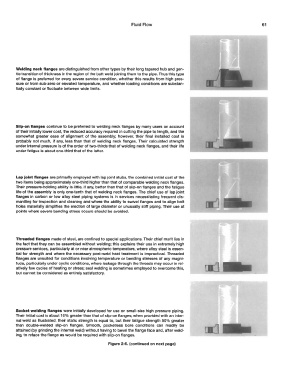
        Welding neck flanges are distinguished from other types by their long tapered hub and gen-
        tle transition of thickness in the region of the butt weld joining them to the pipe. Thus this type
        of flange Is preferred for every severe service condition, whether this results from high  pres-
        sure or from sub-zero or elevated temperature,  and whether loading conditions are substan-
        tially constant or fluctuate between wide limits.


        Sllp-on. flanges continue to be preferred to welding neck flanges by many users on account
        of their initially lower cost, the reduced accuracy required in cutting the pipe to length, and the
        somewhat greater  ease  of alignment of the  assembly;  however,  their final  installed  cost  is
        probably not much,  if any,  less than  that of welding  neck flanges.  Their calculated  strength
        under Internal pressure is of the order of two-thirds that of welding neck flanges, and their life
        under fatigue is about one-third that of the latter.


        Lap Joint flanges are primarily employed with lap joint stubs, the combined initial cost of the
        two items being approximately one-third higher than that of comparable welding neck flanges.
        Their pressure-holding ability is little,  if any,  better than that of slip-on flanges and the fatigue
        life of the assembly is only one-tenth that of welding neck flanges.  The chief use of lap joint
        flanges in carbon  or low alloy steel  piping  systems  is  in  services necessitating frequent dis-
        mantling for Inspection and cleaning and where the ability to swivel  flanges and to align  bolt
        holes materially simplifies the erection of large diameter or unusually stiff piping. Their use at
        points where severe bending stress occurs should be avoided.


        Threaded flanges made of steel, are confined to special applications. Their chief merit lies in
        the fact that they can be assembled without welding; this explains their use in extremely high
        pressure services, particularly at or near atmospheric temperature, where alloy steel  is essen-
        tial  for strength  and  where the necessary post-weld  heat treatment is impractical.  Threaded
        flanges are unsuited for conditions involving temperature or bending stresses of any magni-
        tude,  particularly under cyclic conditions, where leakage through the threads may occur in rel-
        atively few cycles of heating or stress;  seal welding is sometimes employed to overcome this,
        but cannot be considered as entirely satisfactory.


        Socket welding flanges were initially developed for use on small-size high  pressure piping.
        Their initial cost is about 10% greater than that of slip-on flanges; when provided with an inter-
        nal weld as Illustrated, their static strength is equal to,  but their fatigue strength 50% greater
        than  double-welded  slip-on  flanges.  Smooth,  pocketless  bore  conditions  can  readily  be
        attained (by grinding the internal weld) without having to bevel the flange face and, after weld-
        ing, to reface the flange as would be required with slip-on flanges.
                                              Figure 2-6.  (continued on next page)

