


Page 126 - Basic Japanese
P. 126
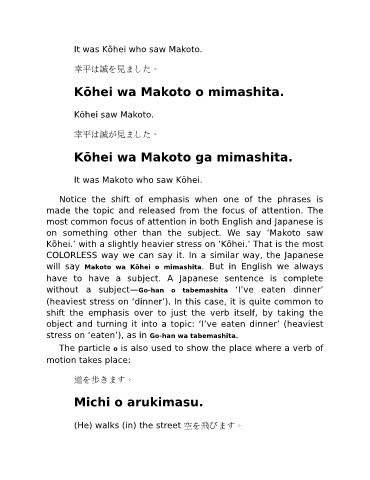
It was Kōhei who saw Makoto.


                          幸平は誠を見ました。


                          Kōhei wa Makoto o mimashita.


                          Kōhei saw Makoto.


                          幸平は誠が見ました。


                          Kōhei wa Makoto ga mimashita.


                          It was Makoto who saw Kōhei.


                     Notice  the  shift  of  emphasis  when  one  of  the  phrases  is
                made  the  topic  and  released  from  the  focus  of  attention.  The

                most common focus of attention in both English and Japanese is
                on  something  other  than  the  subject.  We  say  ‘Makoto  saw
                Kōhei.’ with a slightly heavier stress on ‘Kōhei.’ That is the most

                COLORLESS way we can say it. In a similar way, the Japanese
                will  say  Makoto  wa  Kōhei  o  mimashita.  But  in  English  we  always
                have  to  have  a  subject.  A  Japanese  sentence  is  complete

                without  a  subject—Go-han  o  tabemashita  ‘I’ve  eaten  dinner’
                (heaviest stress on ‘dinner’). In this case, it is quite common to

                shift  the  emphasis  over  to  just  the  verb  itself,  by  taking  the
                object and turning it into a topic: ‘I’ve eaten dinner’ (heaviest
                stress on ‘eaten’), as in Go-han wa tabemashita.

                     The particle o is also used to show the place where a verb of
                motion takes place:


                          道を歩きます。


                          Michi o arukimasu.


                          (He) walks (in) the street 空を飛びます。

