


Page 290 - Dungeon Master's Guide
P. 290
APPENDIX A:  RANDOM DUNGEONS

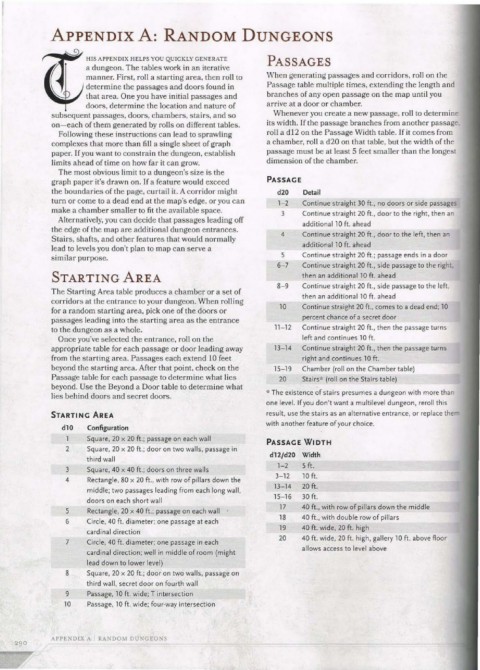
                     HIS APPENDIX HELPS YOU QUICKLY GENERATE   PASSAGES
                     a dungeon. The tables work in an iterative
                     manner. First, roll a starting area, then roll to   When generating passages and corridors, roll on the
                     determine the passages and doors found in   Passage table multiple times, extending the length and
                     that area. One you have initial passages and   branches of any open passage on the map until you
                     doors, determine the location and nature of   arrive at a door or chamber.
             subsequent passages, doors, chambers, stairs, and so   Whenever you create a new passage, roll to determine
             on- each of them generated by rolls on different tables.   its width. If the passage branches from another passage
               Following these instructions can lead to sprawling   roll a d12 on the Passage Width table. If it comes from
             complexes that more than fill a single sheet of graph   a chamber, roll a d20 on that table, but the width of the
             paper. If you want to constrain the dungeon, establish   passage must be at least 5 feet smaller than the longest
             limits ahead of time on how far it can grow.      dimension of the chamber.
               The most obvious limit to a dungeon's size is the
             graph paper it's drawn on. If a feature would exceed   PASSAGE
             the boundaries of the page, curtail it. A corridor might   d20   Detail
             turn or come to a dead end at the map's edge, or you can   1-2   Continue straight 30ft., no doors or side passages
             make a chamber smaller to fit the available space.
                                                                   3    Continue straight 20ft., door to the right, then an
               Alternatively, you can decide that passages leading off
                                                                        additional 10 ft.  ahead
             the edge of the map are additional dungeon entrances.
                                                                   4    Continue straight 20ft., door to the left, then an
             Stairs, shafts, and other features that would normally
                                                                        additional 10 ft.  ahead
             lead to levels you don't plan to map can serve a
             similar purpose.                                      5    Continue straight 20ft.; passage ends in  a door
                                                                  6-7   Continue straight 20ft., side passage to the right.
             STARTING AREA                                              then an additional 10ft. ahead
                                                                  8-9   Continue straight 20ft., side passage to the left,
             The Starting Area table produces a chamber or a set of
                                                                        then an additionallO ft.  ahead
             corridors at the entrance to your dungeon. When rolling
                                                                  10    Continue straight 20ft., comes to a dead end; 10
             for a random starting area, pick one of the doors or
                                                                        percent chance of a secret door
             passages leading into the starting area as the entrance
             to the dungeon as a whole.                          11-12   Continue straight 20ft., then the passage turns
               Once you've selected the entrance, roll on the           left and continues 10 ft.
             appropriate table for each passage or door leading away   13-14   Continue straight 20ft., then the passage turns
             from the starting area. Passages each extend 10 feet       right and continues 10ft.
             beyond the starting area. After that point, check on the   15-19   Chamber (roll on the Chamber table)
             Passage table for each passage to determine what lies   20   Stairs* (roll on the Stairs table)
             beyond. Use the Beyond a Door table to determine what
                                                               ,.,  The existence of stairs presumes a dungeon with  more than
             lies behind doors and secret doors.
                                                               one level.  If you don't want a multilevel dungeon, reroll this
                                                               result, use the stairs as an alternative entrance, or replace t he~
             STARTING  AREA
                                                               with another feature of your choice.
                dlO   Configuration
                      Square, 20 x  20ft.; passage on each wall
                                                               PASSAGE  WIDTH
                 2    Square, 20 x  20ft.; door on two walls,  passage in
                                                                dl2fd20  Width
                      third wall
                                                                  1-2   5 ft.
                 3    Square, 40 x 40 ft.; doors on three walls
                                                                 3-12   lOft.
                 4    Rectangle, 80 x 20ft., with  row of pil lars down the
                                                                 13-14   20ft.
                      middle; two passages leading from each long wall,
                                                                 15-16   30ft.
                      doors on each short wall
                                                                  17    40ft., with  row of pillars down the middle
                 5    Rectangle, 20 x 40ft.; passage on each wall
                                                                  18    40ft., with double row of pillars
                 6    Circle, 40ft. diameter; one passage at each
                                                                  19    40ft. wide, 20ft. high
                      cardinal direction
                                                                  20    40ft. wide, 20ft. high, gallery 10ft. above floor
                 7    Circle, 40ft. diameter; one passage in  each
                                                                        allows access to level above
                      cardinal direction; well  in  middle of room  (might
                      lead down to lower level)
                 8    Square, 20 x 20ft.; door on two wal ls, passage on
                      third wall,  secret door on fourth wall
                 9    Passage, 10 ft.  wide; T intersection
                10    Passage, 10ft. wide; four-way  intersection
             APPENDIX A  I RANDOM  DUNGEONS
     290

