


Page 134 - Module DMV20173
P. 134
7.0 NON CONVENTIONAL PROCESSES


                     7.2  ELECTRICAL-DISCHARGE MACHINING


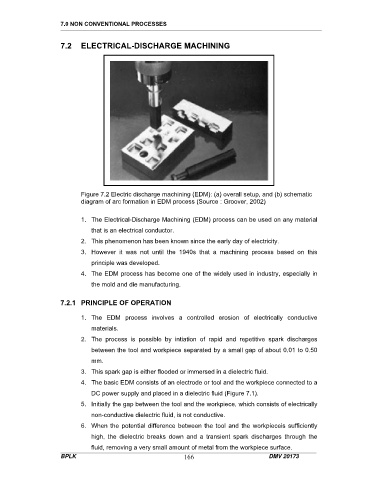
                            Figure 7.2 Electric discharge machining (EDM): (a) overall setup, and (b) schematic
                            diagram of arc formation in EDM process (Source : Groover, 2002)

                            1.  The Electrical-Discharge Machining (EDM) process can be used on any material

                               that is an electrical conductor.
                            2.  This phenomenon has been known since the early day of electricity.
                            3.  However  it  was  not  until  the  1940s  that  a  machining  process  based  on  this

                               principle was developed.
                            4.  The EDM process has become one of the widely used in industry, especially in
                               the mold and die manufacturing.

                     7.2.1  PRINCIPLE OF OPERATION

                            1.  The  EDM  process  involves  a  controlled  erosion  of  electrically  conductive
                               materials.
                            2.  The  process  is  possible  by  intiation  of  rapid  and  repetitive  spark  discharges

                               between the tool and workpiece separated by a small gap of about 0.01 to 0.50
                               mm.
                            3.  This spark gap is either flooded or immersed in a dielectric fluid.
                            4.  The basic EDM consists of an electrode or tool and the workpiece connected to a
                               DC power supply and placed in a dielectric fluid (Figure 7.1).

                            5.  Initially the gap between the tool and the workpiece, which consists of electrically
                               non-conductive dielectric fluid, is not conductive.
                            6.  When the potential difference between the tool and the workpieceis sufficiently
                               high,  the  dielectric  breaks  down  and  a  transient  spark  discharges  through  the

                               fluid, removing a very small amount of metal from the workpiece surface.
                     BPLK                                       166                        DMV 20173

